If you work in business, you have surely encountered the words “branding” and “marketing” many times.
These are two of the most important pillars of business growth, yet, surprisingly often, they are confused or treated as interchangeable.
Many managers believe:
- Branding is advertising
- A brand is a logo
- Marketing means Instagram posts
- Branding is expensive marketing
- Or, worst of all: “If we’re making sales, we’ve built our brand!”
But the reality is different.
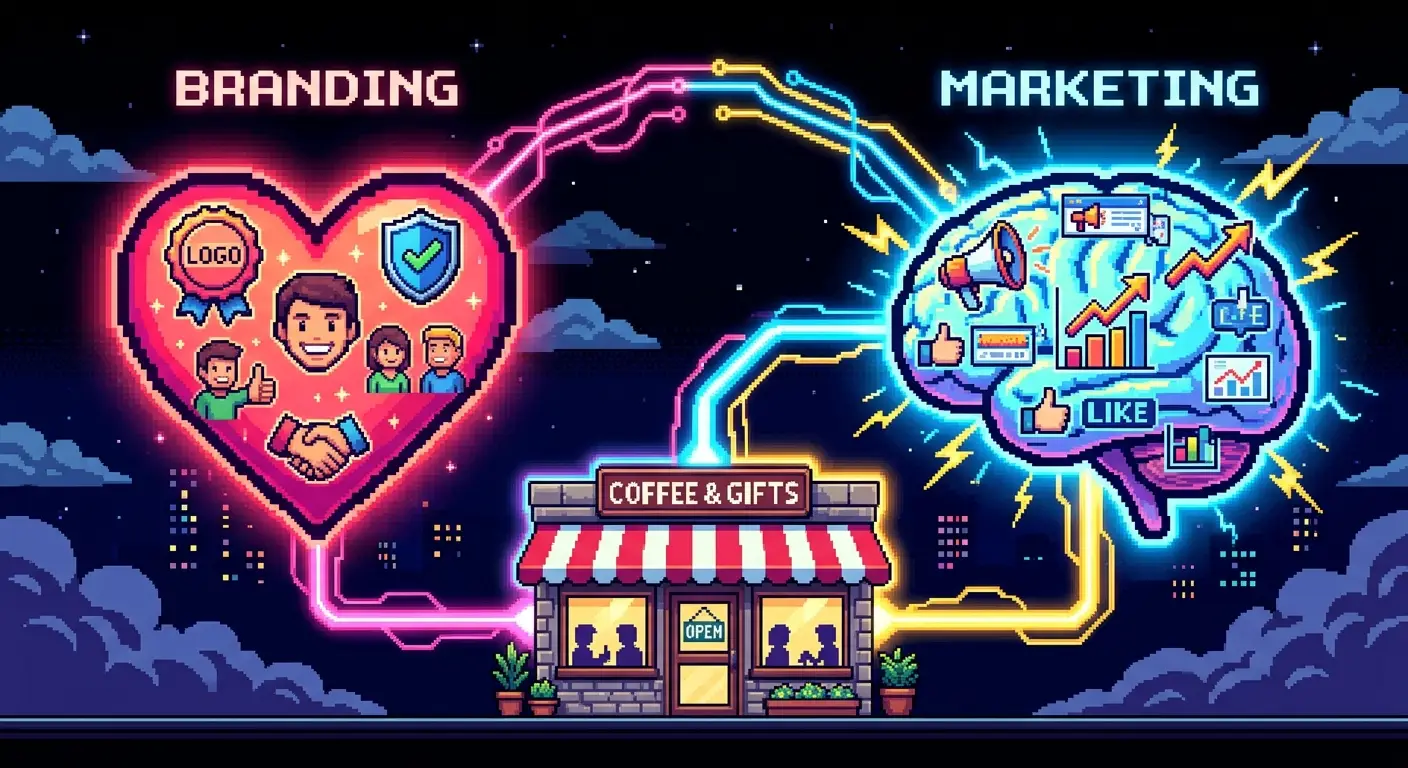
The difference between branding and marketing is like the heart and brain of a business:
Each has a distinct role, but either one is incomplete without the other.
In this article, I’ll explain clearly and practically:
- What is branding?
- What is marketing?
- What is the main difference between them?
- Why do businesses often get it wrong?
- Which should come first?
- Which one helps sales?
- And finally: How can you put them together in practice to get results?
This article is easy to understand for both managers and beginners.
1) What Is Branding? (A Simple, Practical Definition)
Branding means:
Creating a lasting feeling about you in the customer’s mind.
A brand is not a logo.
A brand is not a product.
A brand is not an advertising slogan.
A brand is not even the buying experience.
A brand is the emotional and mental impression an audience has of you.
Real examples:
- People associate “Apple” with simplicity, luxury, and creativity
- “Tesla” means innovation and boldness
- “Coca-Cola” means happiness and friendly moments
- “Snapp” means accessibility and speed
- “Digikala” means comparability and trust
Branding ensures that before, during, and even after a purchase, customers have a consistent picture of you in their minds.
Put very simply:
Branding = managing how people perceive you
People form that perception through:
- Visual identity
- Tone of voice
- Customer experience
- The values you demonstrate
- Employee behavior
- The product
- Services
- Narratives and stories
- Even mistakes and how you make them right
That is how it is built.
2) What Is Marketing? (A Simple, Complete Definition)
Marketing means:
Everything you do to bring your message to market and encourage customers to buy.
Branding works on feelings and perception.
Marketing works on attention and sales.
Marketing is more operational:
- Advertising
- Campaigns
- Social media
- SEO
- Text messages
- Video content
- Sales funnels
- Data analysis
- Discounts and promotions
- Customer personas
- Market research
- Pricing
- And more…
Marketing means introducing, attracting, converting, and retaining customers.
In simpler terms:
Marketing = delivering the right message to the right customer to generate sales
3) The Difference Between Branding and Marketing in One Sentence
If I had to put it in one sentence:
Marketing says, “Why should you buy from us?”
Branding makes people choose you even without hearing that question.
Or, put another way:
- Marketing drives sales today
- Branding drives sales tomorrow, the day after, and for years to come
4) Branding Builds Trust; Marketing Captures Attention
One major difference between the two:
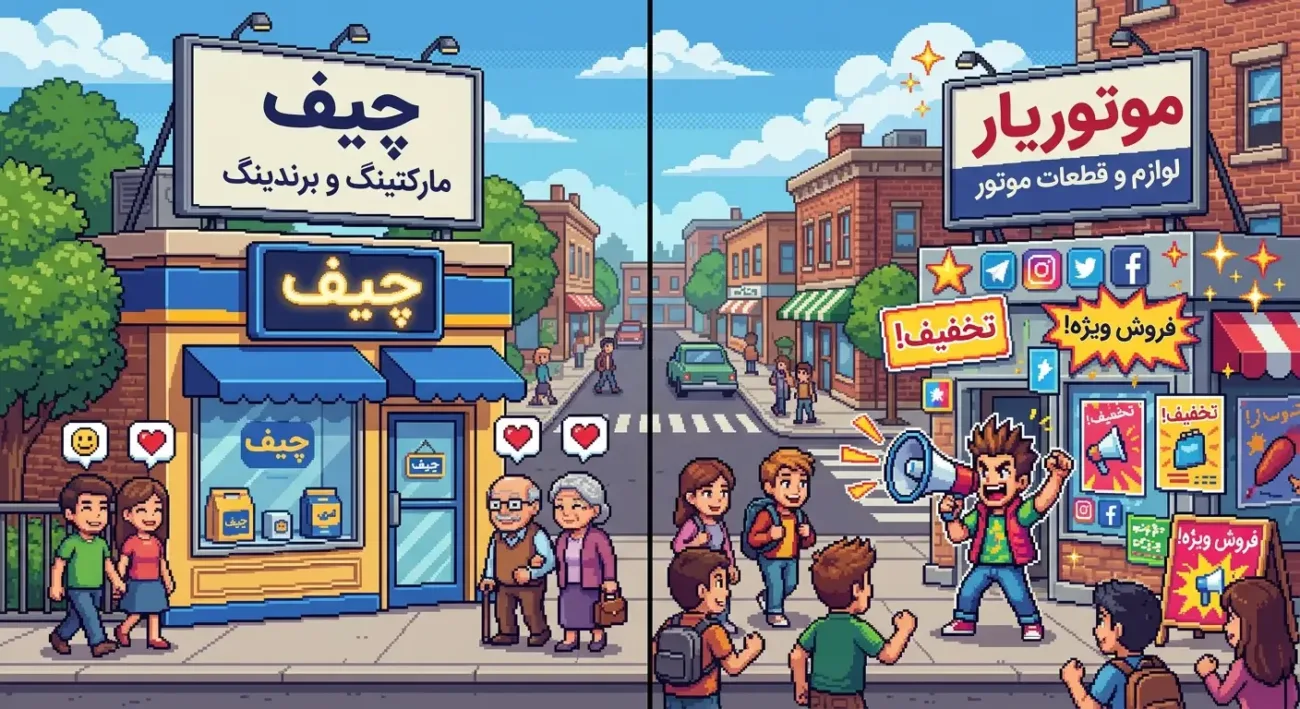
Branding = trust
Marketing = attention
A major marketing campaign can attract the attention of 10 million people;
but without a brand, trust does not form, and sales will be low.
This is what happens to many Iranian businesses:
They advertise for years
but have no sustained sales.
Why?
Because they did not build a brand.
On the other hand:
If you only do branding and no marketing, people may like you, but not enough people will see you.
So:
**Branding without marketing = calm but quiet
Marketing without branding = loud but ineffective**
5) Branding Is Long-Term; Marketing Is Short-Term
If you ask me:
“Is branding a project or a process?”
The definite answer: an ongoing, never-ending process.
Marketing is usually carried out as measurable campaigns:
- Nowruz sales campaign
- New product launch campaign
- Discount campaign
- User acquisition campaign
These are periodic, with a clear start and end.
But people’s “perception” of you is always taking shape.
Branding means managing that perception over the long term.
6) Marketing Is Measurable; Branding Is Less So
Another important difference:
- Marketing is fully measurable: cost per click, customer acquisition cost, conversion rate, churn rate, number of leads, site traffic, sales
- Branding is harder to measure: customer sentiment? Trust? Brand image? Loyalty? Perceived value?
You can create metrics for branding, but they are often indirect and long-term.
That is why many managers make the mistake of cutting the branding budget because:
“We can’t see the results immediately!”
Yet a year or two later, those same managers face falling sales, rising acquisition costs, and a lack of market positioning.
7) Branding Asks “Who Are We?”; Marketing Asks “What Do We Sell?”
Put simply:
Branding = identity
Marketing = activity
Branding answers questions of identity:
- Why do we exist?
- What are our values?
- Why should customers care?
- How do we want to be seen?
- What is our style?
- What position do we want to hold?
Marketing answers operational questions:
- What should we sell, and at what price?
- Whom should we sell to?
- Through which channel?
- With what message and content?
- How do we persuade customers?
The two complement each other:
First you need to know who you are so you can say what you sell.
8) Branding or Marketing First? (A Precise, Non-Clichéd Answer)
This is a common question from managers. The answer is:
Always branding first (at the strategic level)
Then marketing (at the operational level)
But…
Initial branding does not require a highly polished logo, a visual identity campaign, a brand book, and so on.
At first, branding requires just five things:
- Reason for being (why)
- Core values
- Positioning
- Brand promise
- Brand voice and personality
These must be clear before any marketing campaign.
Once the brand identity is defined, you can start practical marketing.
9) Branding’s Role in Reducing Marketing Costs
This section is especially important for managers.
Businesses that do not build a brand:
- Pay more to acquire customers
- Have lower conversion rates
- See fewer returning customers
- Become overly reliant on discounts
- Become dependent on advertising
- Have constantly fluctuating sales
Strong brands, on the other hand, have:
- Lower acquisition costs
- More conversions
- Greater loyalty
- More consistent sales
- Organic growth
- Customers who recommend them
Why?
Because people trust brands, not advertisements.
10) Branding Builds; Marketing Sells
In the simplest, most practical terms:
- Branding builds: credibility, differentiation, identity, trust, emotional connection, loyalty
- Marketing sells: products, services, subscriptions, courses, goods
Branding happens backstage; marketing is onstage.
11) Can Marketing Succeed Without Branding?
Only in the short term.
Many businesses in Iran started with mass advertising, but because they had no brand identity, positioning, or personality, they were quickly forgotten.
They advertised → sales came in
They stopped advertising → sales collapsed
That means:
They were “known,” but they were not a “brand.”
12) Can Branding Grow Without Marketing?
In many cases, yes, but slowly.
If:
- The product is good
- The customer experience is excellent
- Word of mouth is active
growth is possible.
But growth is usually very slow.
13) How Branding and Marketing Work Together
A practical, real-world sequence:
- First, define the brand strategy
- Then build the visual identity and brand voice
- Next, create marketing messages based on that identity
- Run campaigns
- Manage the customer experience in line with the brand
- Feed customer feedback back into the brand
- The brand evolves
- Marketing becomes stronger
A powerful cycle:
Branding → marketing → customer experience → stronger brand → better marketing → increased sales → greater brand value
14) Common Branding and Marketing Mistakes Made by Iranian Managers
Some of the most common mistakes:
- They think a brand is a logo
- They cut the branding budget
- They treat branding as a project
- They think marketing is just content production
- They are impatient and expect immediate results
- They do marketing without a brand strategy
- The brand promise does not match the customer experience
- They use discounts instead of a value proposition
These mistakes can burn a business to the ground.
15) A Real Example to Better Understand the Difference
Imagine two coffee shops:
- Coffee Shop A: advertises and does nothing else
- Coffee Shop B: has professional branding (voice, atmosphere, experience, story, differentiation)
Both advertise.
But the result:
- Coffee Shop A’s customer → visits once
- Coffee Shop B’s customer → returns regularly, recommends it, takes photos, and writes about it
Advertising may bring a customer in,
but branding makes them stay.
16) A Simple, Practical Summary of the Differences
Branding:
- Long-term
- Emotional
- Trust
- Identity
- Perception
- Loyalty
- Indirect
- The why and who of a business
Marketing:
- Short-term
- Operational
- Sales
- Messaging
- Customer acquisition
- Conversion and retention
- Measurable
- How to present a product
17) A Practical Formula for Businesses
If you want to work at the lowest cost and achieve the greatest impact:
- Define your brand strategy first
- Then create a minimal but professional visual identity
- Develop a clear value proposition
- Then start digital marketing and advertising
- Make the customer experience outstanding
- Gather feedback and make improvements
- Embed the brand in customers’ minds
- Expand your advertising
This formula works for startups, shops, service companies, and even personal businesses.
18) Final Summary (In Very Simple Terms)
To sum up the whole discussion in one paragraph:
**Branding means ensuring that when people hear your name, they feel something positive, trustworthy, and lasting.
Marketing means getting those same people to buy from you today.
Marketing without branding is loud but ineffective.
Branding without marketing is credible but slow.
Together, the two are the key to sustainable growth.**


