In digital marketing, one of the most important questions marketing managers, growth managers, and business owners face is:
Which channel, campaign, or touchpoint actually drove the sale, lead, or conversion?
Did the user buy because of a Google ad?
Or because they had previously read an SEO article?
Or did they come back because of retargeting?
Or perhaps they made their decision after seeing several LinkedIn posts, searching for the brand name, and reading customer reviews?
The answer to this question is where the concept of Marketing Attribution comes in.
Marketing Attribution attempts to determine the contribution of each channel, campaign, or touchpoint along the customer’s conversion journey. But the main challenge is this: today’s user journeys are not linear, simple, or fully trackable. That is why traditional attribution models such as Last Click Attribution, and even some simpler Multi-Touch models, are no longer sufficient for many digital businesses.
In this article, we’ll explore what Marketing Attribution is, what models it includes, why traditional models have become limited, and how digital businesses should take a more precise approach to attribution, budgeting, and campaign performance analysis.
What Is Marketing Attribution?
Marketing Attribution is the process of analyzing and determining the contribution of different channels, campaigns, and touchpoints to a marketing outcome, such as a purchase, sign-up, demo request, app install, form submission, or any other conversion.
Simply put, Marketing Attribution aims to answer this question:
Which marketing activities played a role in the customer’s decision, and how much value did each create?
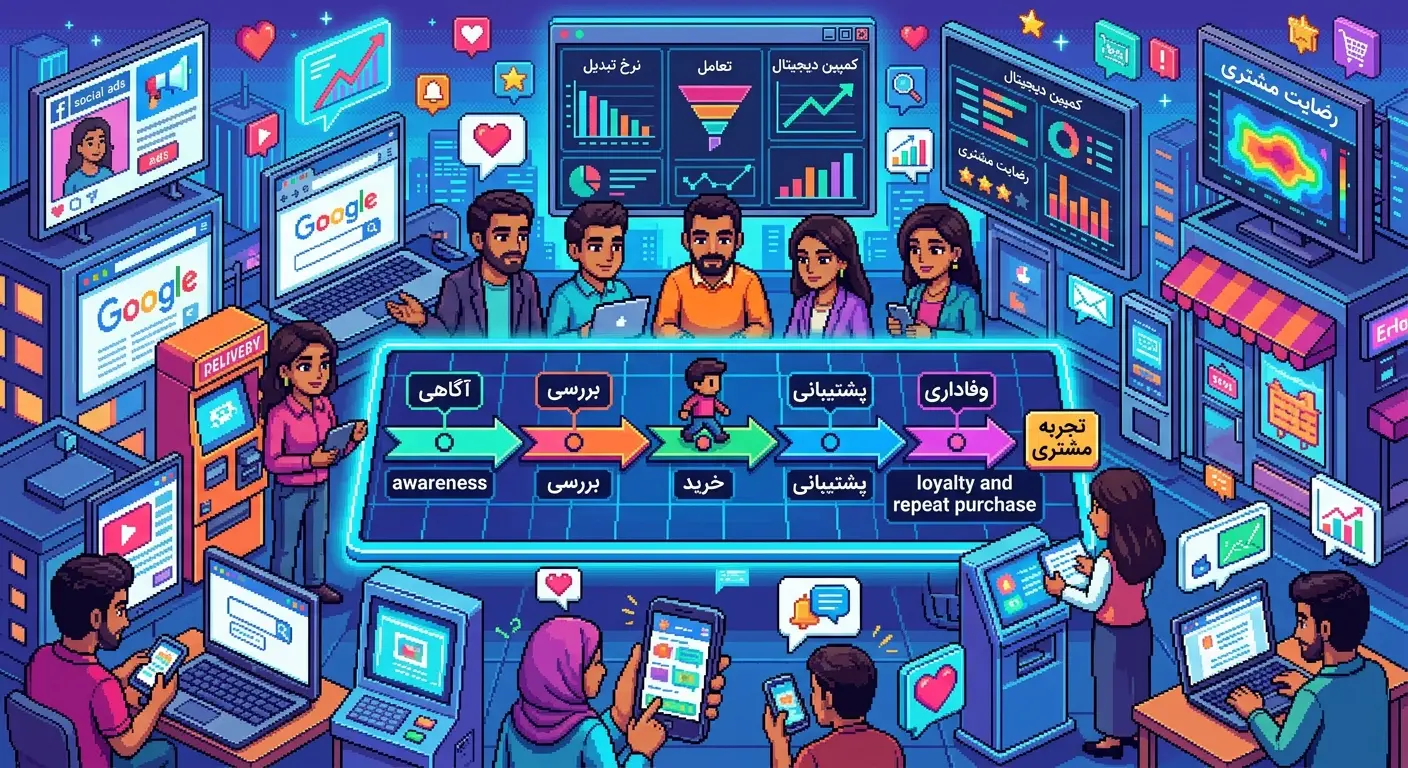
Suppose a user follows this journey:
- First, they discover the brand through an SEO article.
- A few days later, they see an Instagram ad from the brand.
- Then they search for the brand name on Google.
- They visit the site but don’t make a purchase.
- Later, they return through email or retargeting.
- Finally, they make a purchase through a Google ad.
Now the question is:
Which channel should get credit for this purchase?
- SEO?
- Instagram?
- Branded search?
- Email?
- Retargeting?
- Google Ads?
- All of them together?
Marketing Attribution attempts to analyze this journey and determine the relative contribution of each touchpoint.
Why Is Marketing Attribution Important?
Without Attribution, decision-making in digital marketing is severely incomplete. We may see only the channel that recorded the final conversion, while overlooking the channels that built demand, awareness, trust, or consideration.
Marketing Attribution helps businesses:
- Allocate marketing budgets more effectively
- Identify effective channels
- Optimize weak or underperforming campaigns
- See the true role of upper-funnel channels
- Analyze CAC and ROAS more accurately
- Better understand the customer decision-making journey
- Better evaluate the impact of branding and demand generation
- Align Performance, Content, SEO, CRM, and Brand teams
Without proper Attribution, a business may cut the budget for a channel that appears to generate no direct conversions, even though it has played a key role in creating demand and preparing customers to buy.
Common Marketing Attribution Models
Attribution models are generally divided into two main categories:
- Single-Touch Attribution
- Multi-Touch Attribution
1. What Is Single-Touch Attribution?
In Single-Touch models, all credit for a conversion is assigned to just one touchpoint.
Last Click Attribution
In Last Click Attribution, all conversion credit goes to the last channel the user interacted with before converting.
For example, if a user clicks a Google ad before making a purchase, the entire sale is attributed to Google Ads—even if they had previously engaged with the brand several times through SEO, social media, or email.
First Click Attribution
In First Click Attribution, all conversion credit goes to the first touchpoint.
For example, if the user first discovered the brand through an SEO article, all credit for the sale goes to SEO—even if the final conversion happened after several other interactions.
Advantages of Single-Touch Models
- They are simple
- They are easy to implement
- They are suitable for basic reporting
- They can be useful to some extent for short purchase journeys
Main Drawback
These models oversimplify the customer’s real journey and ignore the role of other touchpoints.
2. What Is Multi-Touch Attribution?
In Multi-Touch Attribution models, conversion credit is distributed across multiple touchpoints.
These models aim to be more realistic, because customers usually engage with several different channels and messages before making a purchase.
Linear Attribution Model
In the Linear Attribution model, credit is divided equally among all touchpoints.
For example, if a user interacts with 5 touchpoints, each receives 20% of the credit.
Advantage:
All touchpoints are taken into account.
Drawback:
It assumes all touchpoints were equally important, which is usually not the case.
Time Decay Attribution Model
In the Time Decay model, touchpoints closer to the conversion receive more credit.
For example, a retargeting ad shown shortly before a purchase receives more credit than an initial awareness post.
Advantage:
It is better suited to journeys where interactions close to the purchase matter more.
Drawback:
It may undervalue the role of awareness and demand generation channels.
Position-Based or U-Shaped Attribution Model
In the Position-Based Attribution model, more credit is usually assigned to the first and last touchpoints, with the remaining credit distributed among the touchpoints in between.
For example:
- 40% for the first touchpoint
- 40% for the last touchpoint
- 20% for the touchpoints in between
Advantage:
It accounts for both the role of initial acquisition and that of the final conversion.
Drawback:
It still relies on a fixed assumption and is not necessarily consistent with the real behavior of all users.
W-Shaped Attribution Model
This model is used more often in B2B and lead-focused journeys. It typically distributes credit among several key points:
- First interaction
- Lead creation
- Opportunity creation
- Final conversion
Advantage:
It is useful for businesses with more complex sales cycles.
Drawback:
It requires accurate CRM data and a clear definition of sales stages.
Data-Driven Attribution
In Data-Driven Attribution, rather than distributing credit according to fixed rules, real data and algorithms are used to estimate each touchpoint’s contribution.
These models attempt to determine how much the presence or absence of a channel changes the likelihood of conversion.
Advantage:
It is more realistic than rule-based models.
Drawback:
It requires substantial data, suitable analytics infrastructure, and careful interpretation.
Why Are Traditional Attribution Models No Longer Sufficient?
Traditional attribution models worked better when user journeys were simpler, cookies were more reliable, and digital channels were easier to track. But things have changed today.
Let’s look at the main reasons traditional models are no longer sufficient.
1. The Customer Purchase Journey Is No Longer Linear
In the past, a user might see an ad, click it, and make a purchase. Today, however, the purchase journey is usually more complex.
A user might:
- See the brand on their mobile phone
- Search on their laptop
- Consult with a colleague
- Return to the site several times
- Read customer reviews
- Follow the brand on social media
- Be nurtured through email
- Finally purchase through branded search or direct traffic
Traditional models, especially Last Click, reduce this multi-step journey to a single point.
2. Last Click Overstates the Importance of Bottom-Funnel Channels
One of the biggest problems with Last Click Attribution is that it usually makes bottom-funnel channels appear more valuable than they are.
For example:
- Branded Search
- Retargeting
- Direct Traffic
- Coupon affiliates
- Performance Max
- Shopping Ads close to purchase
These channels often record the final conversion, but they did not necessarily create all the demand.
As a result, a business may mistakenly think:
“Google Ads is our best channel because it brought in the most sales.”
When in fact, many of those sales may have already been primed by content, branding, social media, PR, or awareness campaigns.
3. Upper-Funnel Channels Are Overlooked
Channels such as:
- SEO informational content
- Social Media
- YouTube
- Podcasts
- Influencer Marketing
- PR
- Thought Leadership
- Community
- Brand Campaigns
- Display Awareness
are usually less visible in traditional Attribution models because their impact is not direct, immediate, or click-based.
Yet these very channels can:
- Generate demand
- Build trust
- Increase branded searches
- Improve conversion rates in other channels
- Reduce CAC over the long term
- Increase the brand’s share of mind
If you make decisions based only on Last Click, you will likely cut the budgets of channels that are engines of your long-term growth.
4. Users Move Between Devices and Platforms
A user may see an ad on mobile but make the purchase on desktop. Or they may interact in an app and convert later on the website.
These shifts make it difficult to track the entire journey.
Examples:
- Seeing an ad on Instagram mobile
- Searching for the brand on desktop
- Visiting the site directly
- Making a purchase in a different browser
- Using a VPN
- Deleting cookies
- Switching devices
Traditional models usually cannot accurately capture these cross-device and cross-platform interactions.
5. Cookie Limitations and Data Privacy
With changes related to privacy, tracking users has become more difficult. Factors include:
- Restrictions on third-party cookies
- iOS App Tracking Transparency
- Restrictions in browsers such as Safari and Firefox
- Consent Management
- Reduced pixel accuracy
- Restrictions imposed by advertising platforms
- Server-side tracking and modeled conversions
These factors have made attribution data less complete.
In this environment, relying entirely on traditional click-based models is risky.
6. Dark Social and Untrackable Interactions
A significant part of customer decision-making happens in places that analytics tools usually cannot see accurately.
For example:
- Sharing a link on WhatsApp or Telegram
- Conversations in private groups
- Word-of-mouth recommendations
- Seeing a post without clicking
- Watching a video and searching for the brand later
- Hearing the brand’s name on a podcast
- Consulting with colleagues
- Sales conversations
- Private communities and forums
These spaces are commonly known as Dark Social or the Dark Funnel.
Traditional Attribution models usually attribute these effects to Direct, Organic Search, or Branded Search, even though the actual source of demand was somewhere else.
7. Attribution Is Not the Same as Causation
A common mistake is to treat Attribution as the same thing as Causation.
Attribution tells us:
This touchpoint appeared in the conversion journey.
But Causation asks:
Would the conversion still have happened if this touchpoint had not been there?
For example, if a user already intended to make a purchase and simply clicked a brand ad just before buying, did that ad really cause the purchase? Or was it merely the final route they took to get there?
Many traditional models show only correlation, not the actual incremental effect, or Incrementality.
8. Traditional Models Do Not Measure Brand Impact Well
Branding, trust, reputation, differentiation, and mental familiarity usually do not have a direct, clickable effect. But they influence conversions across all channels.
A strong brand can:
- Increase ad CTR
- Improve landing page conversion rates
- Reduce CAC
- Increase Branded Search
- Grow Direct Traffic
- Help users make decisions faster
- Increase B2B sales close rates
Traditional Attribution models usually fail to capture these effects well because they look for the last click or a trackable path.
A Simple Example of Traditional Attribution Error
Suppose an online store sees the following data over one month:
- Google Search Ads: high sales, excellent ROAS
- SEO Blog: few direct sales
- Instagram Content: few direct sales
- Email: moderate sales
- Retargeting: high sales
If it looks only at Last Click, it will probably cut the SEO and Instagram budgets and increase the budgets for search and retargeting.
But a deeper analysis shows that:
- Users initially arrived through SEO articles
- Instagram built trust and familiarity
- Users then searched for the brand name
- Retargeting simply brought them back
- Branded search recorded the final sale
In this case, Last Click gives an incomplete picture and may lead to poor budgeting decisions.
A New Approach to Marketing Attribution for Digital Businesses
The solution is not to abandon Attribution. Instead, we should use it more intelligently, in combination with other approaches, and more realistically.
1. Combine Attribution with Incrementality Testing
Incrementality means examining how much additional sales or leads a channel or campaign actually generated—not just how many conversions were attributed to it.
For example, to measure the true impact of retargeting, you can exclude some eligible users from the campaign and compare their behavior with that of a group that saw the ad.
If the group that saw the ads performs only slightly better, it means a large portion of those sales would probably have happened anyway.
Incrementality Testing answers a more important question:
If we had not run this campaign, how much of this outcome would have been lost?
2. Using Marketing Mix Modeling
Marketing Mix Modeling, or MMM, is a statistical method for examining the effect of different channels on sales or key KPIs at an aggregate level.
Unlike attribution, which is usually user-level or click-level, MMM looks at aggregate data such as:
- Media spend
- Sales
- Seasons
- Discounts
- Prices
- Competitor activity
- Brand campaigns
- Market conditions
- Offline data
MMM is especially useful when user tracking is incomplete or when channels such as TV, OOH, PR, influencers, and brand campaigns have non-click-based effects.
3. Analyzing Share of Search and Branded Demand
To understand the impact of upper-funnel and branding activity, you should not look only at direct conversions. You should also examine metrics such as:
- Brand Search Volume
- Share of Search
- Direct Traffic
- Branded CTR
- Branded Conversion Rate
- New vs Returning Users
- Organic Branded Queries
- Social Mentions
- Survey-based Awareness
- Consideration Lift
An increase in searches for a brand name is usually a sign of growing mental availability and the impact of brand-building and awareness activity.
4. Analyze the Customer Journey, Not Just the Last Channel
Rather than looking only at which channel a user converted through, examine common conversion paths:
- What are the first touchpoints?
- Which channels assist conversions?
- Which combinations lead to more sales?
- How do the paths of new users differ from those of returning users?
- How do the paths of high-quality leads differ from those of low-quality leads?
This journey-based perspective helps us see channels in their actual roles.
5. Distinguish Channel Roles by Funnel Stage
Not all channels should be measured against a single KPI.
For example:
Upper Funnel
- Reach
- Engagement Quality
- Brand Lift
- Search Lift
- New Users
- Assisted Conversions
- Audience Growth
Mid Funnel
- Returning Users
- Content Engagement
- Lead Magnet Conversion
- Email Signup
- Demo Interest
- Comparison Page Views
Lower Funnel
- Conversion Rate
- CPA
- ROAS
- Sales Qualified Leads
- Purchase
- Revenue
If you expect immediate ROAS from an awareness channel, you are evaluating it unfairly.
6. Using Self-Reported Attribution
In many B2B, SaaS, and service businesses, a simple question on a lead form can provide valuable insight:
How did you first hear about us?
Or:
What made you contact us today?
Answer options could include:
- Word-of-mouth recommendation
- Podcast
- Webinar
- Advertising
- Previous customer
- Website article
- Other
Self-Reported Attribution is not complete or perfect, but it reveals things analytics cannot see—especially dark social and word of mouth.
7. Connect CRM Data to Marketing Data
In many businesses, the attribution problem is not just in advertising; it is that marketing data is not connected to sales quality.
For example, one channel may bring in many leads, but they may be low quality. Another channel may bring in fewer leads, but have a higher conversion-to-customer rate and higher LTV.
For better analysis, connect marketing to the CRM and examine KPIs such as:
- Lead Source
- MQL to SQL Rate
- SQL to Customer Rate
- Revenue by Source
- CAC by Segment
- Sales Cycle Length
- LTV by Channel
- Churn by Acquisition Source
This ensures attribution focuses not only on volume, but also on revenue quality.
What Is the Best Approach to Attribution?
There is no single best model for every business. The right model depends on the type of business, sales cycle length, number of channels, data volume, marketing team maturity, and tracking quality.
But a professional approach is usually a combination of:
- Using Multi-Touch Attribution to analyze the journey
- Using Data-Driven Attribution when there is sufficient data
- Examining Incrementality to measure actual impact
- Using MMM for a high-level view and untrackable channels
- Analyzing Branded Search and Share of Search to understand brand impact
- Using Self-Reported Attribution to uncover the dark funnel
- Connecting CRM and revenue data to assess quality
Put simply:
Attribution should not be the only source of truth; it should be one of several decision-making tools.
Which Businesses Need Advanced Attribution Most?
Almost all digital businesses need some form of attribution, but in some cases it is more critical:
- SaaS businesses
- Online stores with multiple acquisition channels
- Marketplaces
- Mobile apps
- B2B businesses with long sales cycles
- DTC brands
- Companies with substantial advertising budgets
- Brands investing in both performance and brand marketing
- Businesses running SEO, Paid Media, CRM, and Social simultaneously
The longer the purchase journey and the more touchpoints there are, the less adequate simple attribution models become.
Common Mistakes in Marketing Attribution
1. Trusting Last Click Completely
Last Click is simple, but it usually gives an incomplete picture of the customer journey.
2. Comparing Every Channel by Immediate ROAS
Not every channel is designed to drive direct sales. Some channels build demand and trust.
3. Ignoring Assisting Channels
A channel that does not record the final conversion may still play an important role in preparing the customer.
4. Treating Attribution as Actual Impact
A channel appearing in the conversion path does not necessarily mean it caused the conversion.
5. Analyzing Conversions Without Considering Revenue Quality
A high number of leads does not always mean healthy growth. Lead quality, LTV, and the conversion rate to customers should also be examined.
6. Ignoring Qualitative Data
Customer interviews, self-reported forms, and sales conversations can reveal things that analytics tools cannot see.
7. Making Budget Decisions Based Only on Platform Dashboards
Each ad platform usually tends to assign more value to itself. The data should be cross-checked.
Key KPIs in Marketing Attribution
Depending on the business objective, the following KPIs are useful in attribution analysis:
- Conversion Rate by Channel
- Assisted Conversions
- First-Touch Conversions
- Last-Touch Conversions
- Multi-Touch Revenue
- CAC by Channel
- ROAS
- MER / Marketing Efficiency Ratio
- LTV by Acquisition Source
- Lead-to-Customer Rate
- MQL to SQL Rate
- Sales Cycle Length by Source
- Branded Search Volume
- Direct Traffic Growth
- Incremental Revenue
- Cost per Incremental Conversion
- Share of Search
- New Customer Revenue
- Repeat Purchase Rate by Source
How Is Marketing Attribution Different in B2B?
Attribution is more complex in B2B because purchase decisions are usually not made by one person, and sales cycles are longer.
B2B challenges include:
- Multiple decision-makers in a buying committee
- Long-running interactions with content
- The important role of sales and demo meetings
- Untrackable paths such as referrals and internal conversations
- A long gap between the first interaction and the purchase
- The importance of lead quality, not just lead volume
In B2B, CRM and pipeline data must also be included in the analysis alongside digital attribution.
For example, more important than how many forms a channel generated is:
- How many SQLs did it generate?
- How much pipeline did it create?
- How many deals did it close?
- What was the average deal size?
- How long was the sales cycle?
- How was the retention and expansion of those customers?
How Is Marketing Attribution Different in E-commerce?
E-commerce usually has more data and shorter purchase cycles, but challenges such as cross-device journeys, retargeting, discounts, and branded search are highly significant.
Online stores should keep in mind that:
- Retargeting may claim sales that would have happened anyway
- Branded search often captures demand rather than creates demand
- Discounts can distort attribution
- Repeat customers should not be analyzed as if they were new customers
- Platform ROAS may be over-attributed
- MER matters alongside ROAS
In E-commerce, attribution analysis must distinguish between new and repeat customers.
Marketing Attribution means analyzing which channels, campaigns, and touchpoints played a role in the customer’s conversion journey and what share of the outcome each contributed.
But traditional models such as Last Click or First Click are no longer sufficient for many digital businesses because:
- The customer journey is not linear
- Users move between devices and channels
- Cookies and tracking have become more limited
- Dark social and word of mouth cannot be fully tracked
- Upper-funnel channels are overlooked
- Attribution does not necessarily show causation
- Brand impact and demand generation are not clearly visible
The solution is to take a combined perspective:
Combine Multi-Touch Attribution, Data-Driven Attribution, Incrementality Testing, Marketing Mix Modeling, Self-Reported Attribution, branded search analysis, and CRM data integration.
Ultimately, attribution is not meant to provide a definitive, complete answer. It is meant to support better decision-making. Sophisticated brands view attribution not as “absolute truth,” but as one of the tools for understanding customer behavior, allocating budgets, and optimizing growth.
Frequently Asked Questions About Marketing Attribution
1. What is Marketing Attribution?
Marketing Attribution is the process of determining the contribution of different channels, campaigns, and touchpoints to generating a conversion, sale, or lead.
2. Why is Marketing Attribution important?
It helps us understand which marketing activities actually play a role in the customer’s purchase journey and allocate the marketing budget more intelligently.
3. What is Last Click Attribution?
It is a model that gives all conversion credit to the last channel the user interacted with before converting.
4. What is the main problem with Last Click?
Last Click ignores the role of earlier channels such as SEO, social media, branding, PR, and educational content, and usually overvalues bottom-funnel channels.
5. What is Multi-Touch Attribution?
It is a model that distributes conversion credit across multiple touchpoints in the customer journey, rather than assigning it to just one channel.
6. Is Attribution the same as Causation?
No. Attribution shows which touchpoints appeared in the conversion path, while Causation asks whether those touchpoints actually caused the conversion.
7. How does Incrementality Testing help with Attribution?
Incrementality Testing shows how much sales or lead volume would have been lost if a campaign or channel had not run. This method better identifies the actual incremental impact.
8. Why are traditional Attribution models insufficient for digital marketing?
Because users’ purchase journeys are multichannel, nonlinear, cross-device, and to some extent untrackable, while traditional models simplify this complexity.
9. How is Dark Social related to Attribution?
Dark Social refers to interactions such as recommendations in messaging apps, private groups, conversations, and view-through exposure that analytics tools usually cannot track accurately.
10. Which Attribution model is best?
There is no single best model for every business. A combination of Multi-Touch Attribution, Data-Driven Attribution, Incrementality, MMM, and CRM data usually provides the clearest view.
11. How is Marketing Attribution different in B2B?
In B2B, the sales cycle is longer and there are multiple decision-makers, so CRM, pipeline, SQL, and revenue data must be analyzed alongside digital data.
12. Do small businesses need Attribution too?
Yes, but not necessarily with complex tools. Even a simple analysis of first-touch, last-touch, self-reported source, and lead quality can improve marketing decisions.