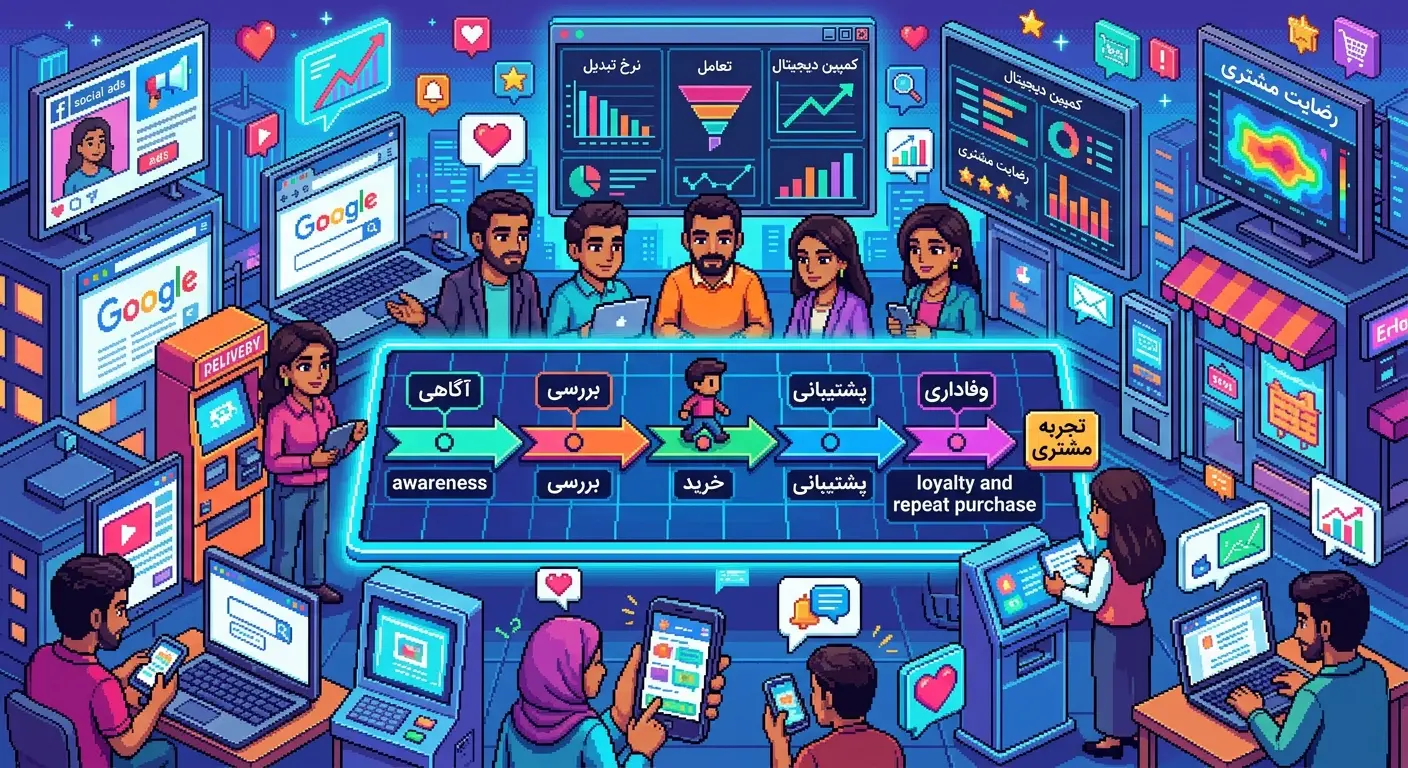
In many businesses, digital marketing campaigns are designed around channels, not real customer behavior. One team focuses on Google Ads, another runs Instagram, the content team works on SEO, and sales follows its own path. The result is a brand that appears active across several channels, while the customer experience is fragmented, inconsistent, and sometimes confusing.
In these circumstances, one of the most important strategic tools for creating a consistent customer experience and increasing campaign effectiveness is Customer Journey Mapping, or customer journey mapping.
Customer Journey Mapping helps a business understand the path a customer takes from their first point of contact with the brand through purchase, use, loyalty, and even recommending it to others; what questions they have at each stage, what obstacles they encounter, which channels they engage with, and what makes them progress or drop off.
In this article, we take an in-depth look at what Customer Journey Mapping is, why it matters in digital marketing, how it differs from Funnel and User Flow, what its main components are, and how it can be used to improve digital campaigns.
What Is Customer Journey Mapping?
Customer Journey Mapping is the process of documenting and analyzing the actual or desired path a customer takes while interacting with a brand—from the moment a need, problem, or initial awareness arises until a purchase is made, the experience of using the product continues, and the relationship with the brand deepens.
Simply put, a customer journey map is a structured picture of the following question:
Where does our customer enter, what experience do they have along the way, and why do they move forward or stop at certain points?
This map usually includes:
- The different stages of the customer journey
- Brand touchpoints
- Customer behaviors and actions
- Motivations and expectations
- Emotions and concerns
- Obstacles and frictions
- Channels involved
- Opportunities to improve the experience
- Messages and content suited to each stage
A Customer Journey Map is not merely a pretty diagram; when built correctly, it becomes one of the most important decision-making tools in marketing, sales, product, CX, and branding.
Why Is Customer Journey Mapping Important?
Many campaigns perform poorly because they look only at the “moment of the click” or “moment of purchase,” rather than the customer’s entire decision-making journey. Yet a purchase decision, especially in competitive markets, is usually the result of a multi-stage process.
Customer Journey Mapping matters because it:
- Shows actual customer behavior instead of internal team assumptions
- Reveals drop-off and friction points
- Helps deliver the right message at the right stage
- Turns channels from isolated efforts into an integrated journey
- Improves the customer experience
- Increases conversion rates
- Reduces CAC
- Helps align marketing, sales, and product
- Makes it possible to design full-funnel campaigns
In fact, without understanding the customer journey, many digital optimizations are merely tactical, not strategic.
How Does the Customer Journey Differ from the Marketing Funnel?
These two concepts are related, but they are not the same.
Marketing Funnel
The marketing funnel usually shows the audience’s progress from the business’s perspective. For example:
- Awareness
- Consideration
- Conversion
- Retention
A funnel is mostly a simplified analytical model that shows how many users are at each stage and how they move to the next ones.
Customer Journey
The Customer Journey, on the other hand, examines the path from the customer’s perspective.
It asks:
- What does the customer want at this stage?
- What questions do they have?
- What do they feel?
- What obstacles do they encounter?
- Which channel are they on?
- What makes them move forward or stop?
In short
- Funnel is more quantitative and stage-based
- Journey is more behavioral, experiential, and human
The funnel says how many people dropped off.
The Journey says why they dropped off.
How Does Customer Journey Mapping Differ from User Flow?
User Flow usually refers to the path a user takes within a product, website, or app. For example:
- Visit a product page
- Add an item to the cart
- Enter information
- Pay
- Order confirmation
But Customer Journey has a broader scope and is not limited to behavior within a product. The map can begin before a customer visits the website and continue after purchase.
For example:
- See a video on Instagram
- Search for the brand on Google
- Visit the website
- Compare prices
- Consult a colleague
- Click on retargeting
- Make a purchase
- Receive an onboarding email
- Use the product
- Recommend it to others
Therefore, User Flow is part of the Customer Journey, not its equivalent.
The Main Components of a Customer Journey Map
A professional Customer Journey Map usually consists of several layers.
1. Persona or Segment
The first thing to understand is that the customer journey is not the same for everyone.
A marketing manager at a B2B company, a stay-at-home mother shopping online, a freelance SaaS user, and a corporate purchasing manager all have different journeys.
Therefore, the journey map should be designed for a specific persona or segment.
For example:
- Marketing manager at a medium-sized company
- Startup founder
- Repeat customer of an online store
- New user of a financial app
- Prospective branding-services customer
If you create a single Journey Map for all audiences, it will usually be too general and of limited use.
2. Stages of the Journey
The customer journey is usually divided into several stages. These can vary depending on the business, but a common model includes:
- Awareness
- Consideration
- Evaluation
- Purchase / Conversion
- Onboarding
- Usage
- Retention
- Advocacy
In some businesses, the stages are shorter or longer. For example, in B2B, Evaluation and Validation may be very thorough. In DTC or E-commerce, Purchase may happen faster, while Retention becomes more important.
3. Customer Actions
At each stage, identify exactly what the customer does.
For example, at the Awareness stage:
- Search for a problem on Google
- See a social media post
- Click an ad
- Watch a video
- Hear the brand’s name from a colleague
At the Consideration stage:
- Read a comparison article
- Review user feedback
- Visit a services page
- Compare with competitors
- Subscribe to a newsletter
At the Purchase stage:
- Request a demo
- Add an item to the cart
- Fill out a form
- Contact sales
- Place an order
Recording these actions helps you analyze touchpoints and drop-off points more precisely.
4. Touchpoints
A Touchpoint is any point at which a customer interacts with a brand.
These touchpoints may be owned, paid, or earned.
Examples of Touchpoints:
- Google search results
- Google Ads
- Landing page
- Webinar
- Sales call
- Live chat
- Pricing page
- FAQ page
- User reviews
- Retargeting
- User dashboard
- Text message
- Support
One important value of Journey Mapping is showing that customers do not encounter just one channel; they usually pass through several touchpoints.
5. Thoughts, Questions, Motivations
Customers have different questions and motivations at each stage.
For example:
At Awareness
- What is my problem, exactly?
- What solution is available for this issue?
- Is this worth looking into?
At Consideration
- Which brand is a better fit?
- What is the difference between these options?
- Can this brand be trusted?
At Purchase
- Is the price reasonable?
- Is the purchasing process safe and simple?
- What happens if something goes wrong?
At Retention
- Does this product really provide value for me?
- Should I buy from this brand again?
- Could I recommend it to others?
Without this layer, a Journey Map becomes merely a channel diagram, rather than a customer-focused decision-making tool.
6. Emotions
The customer journey is not only rational; it is emotional, too.
At many points, emotions determine whether a customer continues.
For example:
- Curiosity
- Confusion
- Doubt
- Hope
- Anxiety
- Confidence
- Excitement
- Frustration
- Satisfaction
Showing emotions in the Journey Map helps you understand where the experience turns negative and needs intervention.
7. Pain Points / Frictions
One of the most important outcomes of a customer journey map is identifying friction points.
Examples of Pain Points:
- The brand message is unclear
- The landing page does not align with the ad
- The form is too long
- Pricing is not transparent
- Not enough trust has been established
- Answers to important questions are missing
- The registration process is complicated
- Retargeting is irrelevant
- There is not enough content for the decision-making stage
- Onboarding is poor after purchase
This section directly leads to improvements in campaigns and the customer experience.
8. Opportunities
Along with pain points, opportunities should also be recorded:
- What type of content is missing?
- Where should the CTA be revised?
- Which channel should be strengthened?
- Where do we need social proof?
- Where do we need automation?
- Where should the message be personalized?
- Where can friction be reduced?
A good Journey Map does not just show the problem; it also clarifies the path to improvement.
How Is Customer Journey Mapping Created?
A customer journey map should not be built solely on the internal team’s guesses. Creating one requires a combination of data, research, and analysis.
1. Define the Map’s Goal
First, decide what you want to achieve by creating a Journey Map.
For example:
- Improve landing page conversion rate
- Understand why leads drop off
- Design a full-funnel campaign
- Improve onboarding
- Increase retention
- Align marketing and sales
- Optimize the website purchasing experience
Without a clear goal, the map may become too broad and impractical.
2. Choose a Persona or Segment
As mentioned, not all customers have the same journey.
So you need to select a specific segment.
For example:
- Inbound leads from SEO
- New store customers
- Users who request a demo
- HR managers at medium-sized companies
- Mobile shoppers
3. Collect Data
Several types of data are used to build the map:
Quantitative Data
- Google Analytics / GA4
- Search Console
- CRM
- Funnel Reports
- Conversion Paths
- Attribution Data
- Heatmaps
- Session Recordings
- Email Performance
- Ad Platform Data
Qualitative Data
- Customer interviews
- Interviews with lost leads
- Surveys
- Support chats
- Sales calls
- Comments and reviews
- Social Listening
Quantitative data tells you what happened; qualitative data tells you why.
4. Identify Stages and Touchpoints
Use the data to document the customer’s actual journey:
- Where did they enter from?
- What content did they see?
- Which pages did they view?
- How long did it take?
- Which channels played a role in the decision?
- Where did they drop off or move forward?
5. Build the Behavioral and Emotional Layers
At each stage, record the following:
- Customer action
- Customer goal
- Customer concern
- Customer emotion
- Main obstacle
- Touchpoint
- Opportunity for improvement
6. Validate the Map
After creating the first version, review it with different teams and even real customers.
Many Journey Maps look good on paper but do not match market reality.
7. Turn the Map into an Action Plan
This is the most important stage.
If the customer journey map does not lead to decisions and action, it is just a presentation file.
You need to determine:
- Which pain points have the highest priority?
- Which team is responsible for resolving each one?
- Which KPIs should change?
- Which tests should be run?
- What content should be produced?
- Which campaign should be redesigned?
How Does Customer Journey Mapping Improve Digital Campaigns?
Now we come to the main question: exactly how does this map improve digital campaigns?
1. Helps Design Full-Funnel Campaigns
Many brands work only on awareness or only on conversion.
Journey Mapping shows what customers need at each stage, so campaigns can be designed to cover the entire journey.
For example:
- At Awareness: educational content, video, category advertising
- At Consideration: case study, comparison, testimonials
- At Conversion: a clear offer, strong CTA, optimized landing page
- At Retention: onboarding email, education, cross-sell
The result is that the campaign does not merely attract an audience; it moves them forward in their decision-making journey.
2. Improves Message-Market Fit at Every Stage
Customers have different questions at each stage.
If the campaign message is not aligned with their stage, response rates fall.
For example, showing a direct sales message to a user who does not yet clearly understand their problem usually gets a poor response.
Journey Map helps you design the right message for each stage.
3. Increases Alignment Across Channels
A user may see one message in an ad, then have a completely different experience on the landing page. Or the email content may not match what they see on the sales page.
Journey Mapping reveals these disconnects and helps:
- Align ads and landing pages
- Connect SEO and conversion content
- Design retargeting according to the user’s stage
- Make CRM and sales a natural continuation of the marketing journey
4. Identifies Campaign Drop-Off Points
Sometimes the problem is not the ad itself, but the step after the click.
Journey Mapping helps you find exactly where drop-off occurs:
- Before the visit?
- After the landing page?
- After viewing pricing?
- After registration?
- After a sales call?
- After the first purchase?
This perspective prevents superficial optimization.
5. Optimizes Content Around Customers’ Real Needs
When you understand the customer journey, you do not create content for an algorithm or internal preferences; you create it to answer customers’ real questions.
For example, you may find that customers need this content at the consideration stage:
- Competitor comparisons
- In-depth FAQs
- Case study
- ROI calculator
- Demo video
- Onboarding explainer
- Objection handling content
This allows content to play a real role in moving users through the funnel.
6. Improves Segmentation and Personalization
Journey Mapping shows that users are not all in the same situation.
Campaigns can therefore be personalized according to stage and intent.
For example:
- New user: awareness content
- Returning user: proof and comparison
- Abandoned-cart user: a message that addresses the obstacle
- Existing customer: retention or upsell
This approach improves relevance and increases conversion.
7. Improves Attribution and Performance Analysis
When you understand the customer journey better, you can evaluate the role of channels more realistically.
For example, you may realize that Instagram does not drive the final conversion but plays an important role in building awareness. Or SEO brings in the initial lead, while email and retargeting complete the purchase.
As a result, budget decisions become more rational.
8. Increases Retention and LTV
Many Journey Maps make a common mistake: they end at purchase.
Yet in many businesses, the real value begins after the purchase.
A customer journey map helps you see:
- Is onboarding working well?
- Does the user reach value quickly?
- Does communication continue after purchase?
- Are there cross-sell and upsell opportunities?
- Does the customer become an advocate?
This perspective ensures digital campaigns are not focused solely on acquisition.
A Practical Example of Customer Journey Mapping in Digital Marketing
Suppose a SaaS company offers project management services.
Awareness Stage
The user has realized their team works in a scattered and disorganized way.
Touchpoints:
- Google search: “best project management tool”
- LinkedIn post
- YouTube video
Need:
- Understand the solutions
- Become familiar with the options
Suitable content:
- Educational article
- Category video
- Project management checklist
Consideration Stage
The user compares several tools.
Touchpoints:
- Feature pages
- Review sites
- Comparison page
- Webinar
Needs:
- Differences between tools
- Pricing
- Features
- Trust
Suitable content:
- Competitor comparison
- Case study
- Demo
- Testimonial
Conversion Stage
The user wants to start a trial.
Pain Point:
- Long form
- Unclear plan descriptions
- Weak CTA
Improvements:
- Shorten the form
- Clarify pricing
- Improve the activation email
- Remarketing for incomplete signups
Retention Stage
The user has signed up, but their team is not yet active.
Pain Point:
- Poor onboarding
- Long time-to-value
Improvements:
- Step-by-step onboarding email
- Quick setup video
- In-app guidance
- Success team call
This example shows how Journey Mapping affects campaigns from awareness through retention.
Common Mistakes in Customer Journey Mapping
1. Building the Map on Internal Assumptions
If the map is created only from the team’s assumptions, it will usually be far from the customer’s reality.
2. Treating Every Customer’s Journey as the Same
Different segments and personas have different journeys.
3. Focusing Only on the Pre-Purchase Stage
A large part of a brand’s value takes shape after conversion.
4. Ignoring Emotions and Obstacles
A map without emotional and friction layers is incomplete.
5. Failing to Turn the Map into Action
A Journey Map should lead to an improvement roadmap, not just documentation.
6. Failing to Update the Map
Customer behavior, channels, and markets change. The map needs updating, too.
The Best KPIs for Evaluating Journey Mapping’s Impact on Campaigns
Depending on the goal, you can track these KPIs:
- Conversion Rate
- Lead-to-Customer Rate
- CAC
- CPL
- CTR
- Bounce Rate
- Landing Page Conversion
- Time to Purchase
- Assisted Conversions
- Email Open / Click Rate
- Demo Request Rate
- Activation Rate
- Retention Rate
- Repeat Purchase Rate
- LTV
- NPS / CSAT
- Drop-off Rate at key stages
Customer Journey Mapping is the process of analyzing and documenting a customer’s actual journey in interacting with a brand—from the moment a need arises through purchase, use, and loyalty. This tool helps you adopt a customer-focused perspective instead of a channel- or campaign-focused one.
In digital marketing, customer journey mapping is highly valuable because it:
- Reveals drop-off points
- Identifies the right message for each stage
- Integrates channels
- Improves content and landing page quality
- Makes full-funnel campaigns possible
- Improves conversion and retention
Simply put, Customer Journey Mapping helps you understand that customers do not merely pass by your ad; they experience a decision-making journey.
The better you understand this journey, the more precise, coordinated, and profitable your campaigns become.
Frequently Asked Questions About Customer Journey Mapping
1. What is Customer Journey Mapping?
It is the process of mapping and analyzing a customer’s journey while interacting with a brand, from initial awareness through purchase, use, and loyalty.
2. Why is customer journey mapping important in digital marketing?
Because it helps us understand what customers need at each stage, where they drop off, and how campaigns and the experience can be improved.
3. What is the difference between Customer Journey and Marketing Funnel?
Funnel shows the journey from the business’s perspective, usually as a set of quantitative stages, while Customer Journey also considers the customer’s experience, emotions, questions, and obstacles.
4. Is Customer Journey Mapping only for large businesses?
No. Even small businesses can use this method to better identify weaknesses in their customer journey and campaigns.
5. What are the components of a customer journey map?
It usually includes personas, journey stages, customer actions, touchpoints, emotions, questions, pain points, and opportunities for improvement.
6. How does Customer Journey Mapping help improve campaigns?
By identifying the customer’s mindset at each stage, drop-off points, channel misalignment, and the content needs of each segment, it makes campaigns more precise and effective.
7. Is Customer Journey Mapping the same as User Flow?
No. User Flow usually shows a user’s path through a website or app, while Customer Journey has a much broader scope and covers the entire interaction with a brand.
8. What data should be used to build a Journey Map?
Use a combination of quantitative data such as GA4, CRM, and Funnel Reports, and qualitative data such as customer interviews, support chats, surveys, and sales calls.
9. When should a Journey Map be updated?
Whenever the market, customer behavior, channels, product, or marketing strategy changes. In practice, a quarterly or six-month review is useful.
10. What is the biggest mistake in Customer Journey Mapping?
Building the map on internal assumptions and failing to turn it into practical actions to improve the experience and campaigns.


