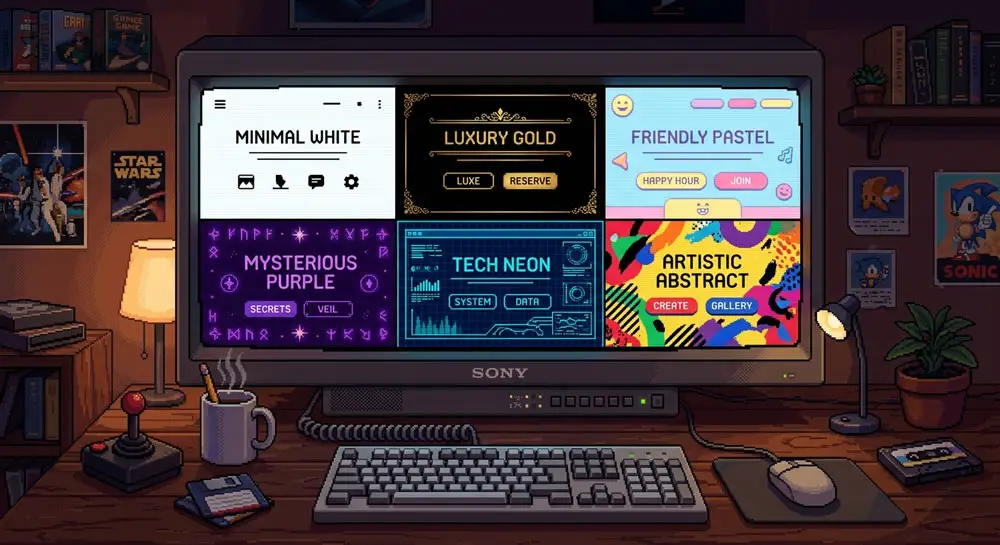
Designing a Distinctive Mood
How can a website create a distinctive feeling, atmosphere, and emotional space?
Website design has long moved beyond being a purely functional tool and has become an emotional space—a space users do not merely see, but feel. Today, brands understand that the user experience is not just a collection of buttons, text, and images; it is an emotional mood that takes shape as soon as users arrive and stays with them.
A website can convey calm minimalism, create a luxurious setting, suggest advanced technology or artistry, or even evoke mystery. This article explores how a website can create a complete emotional atmosphere for users—and which design elements shape that mood.
What Is Mood, and Why Does It Matter in Web Design?
Mood is a website’s “dominant feeling” or “emotional atmosphere”—something that goes beyond visual style.
Mood is the combination of feelings created by all the elements on a page:
- Colors
- Writing tone
- Spacing and empty space
- Types of images
- The rhythm of movement (animations)
- Sound (if present)
- Shapes and lines
- Even the page content
The right mood makes users feel, “I’m in the right place,” and that feeling affects their decisions: stay or leave, buy or abandon, trust or distrust.
In web design, mood is the personality of a space.
Why Does the Human Brain Recognize a Site’s Mood So Quickly?
The human brain recognizes an environment’s emotional atmosphere in less than three seconds. This ability is a legacy of human survival:
“Is this environment safe? Is it friendly? Is it serious? Does it have energy?”
Websites work the same way. When users arrive, they sense the space’s emotional tone without reading the text, based on visual elements, speed, whitespace, colors, and even how the UI behaves.
The right mood creates belief, trust, and readiness to interact.
The wrong mood creates resistance, fatigue, and a quick exit.
The Core Elements That Create a Website’s Emotional Mood
A site’s mood comes from harmony among the elements below. None is enough on its own; the real art lies in making them work together.
1. Colors
Colors are the foundation of mood.
For example:
- Light colors + white → a sense of purity / minimalism
- Black + gold → a sense of luxury
- Green + natural textures → a sense of calm and nature
- Cool blues → a sense of technology
- Red and orange → energy, youth, and boldness
Colors deliver the first emotional message.
2. Typography
Fonts define a site’s personality:
- Classic serif → formal / luxurious
- Geometric sans serif → modern / technological
- Handwritten → friendly / artistic
- Bold, heavy type → powerful / daring
The right typography brings a page’s mood to life.
3. Images and Graphic Style
Images can change the entire emotional tone:
- Darkly lit images → mysterious
- Bright, cheerful images → friendly
- Minimal images with few details → calm
- Highly detailed images → energetic or complex
- CGI or 3D → technological
4. Whitespace
The amount of whitespace is important to mood:
- More space → calm, seriousness, luxury
- Less space → high energy, youthfulness, dense information
5. Animation Rhythm and Speed
Movement brings a space’s feeling to life:
- Slow movements → calm or luxurious atmosphere
- Fast movements → technological or youthful feel
- Subtle micro-interactions → friendly and human
- Soft fades → emotional and artistic
- Sharp slides → seriousness and strength
6. Content Tone
Content is also part of a site’s mood:
- Friendly: “Hello! Welcome :)”
- Formal: “Welcome to our platform”
- Luxurious: “A different experience, for the most discerning”
- Technological: “Next-generation solutions”
- Artistic: “Beauty in the lines, meaning in the light”
7. Sound (in Special Cases)
Artistic or experiential websites sometimes use sound or gentle music.
Common Website Moods and How to Create Them
In this section, we explore the most important emotional atmospheres and explain which design elements create each mood.
1. Minimal Mood
(Calm, orderly, professional, bright)
Characteristics:
- Plenty of white space
- Light, neutral colors
- Simple, modern fonts
- Very minimal images
- Very soft animations
- Few elements, with clarity as the priority
Feeling conveyed:
Calm, purity, professionalism, focus.
Suitable for:
Design studios, modern luxury brands, apps, and SaaS products.
2. Luxury Mood
(Expensive, rare, aristocratic, dignified)
Characteristics:
- Dark colors + single-tone gold / silver
- Elegant serif fonts
- Professionally lit images
- Plenty of whitespace
- Slow, precise movements
Feeling conveyed:
High value, trust, exclusivity, quality.
Suitable for:
Jewelry, fashion brands, specialized consulting services, luxury cars.
3. Friendly Mood
(Warm, welcoming, cheerful, human)
Characteristics:
- Bright, warm, or pastel colors
- Rounded, soft fonts
- Human imagery or illustrations
- Playful micro-interactions
- Rounded, welcoming buttons
Feeling conveyed:
Security, joy, comfort, and an approachable brand.
Suitable for:
Social apps, children’s brands, startups, home services.
4. Technological Mood
(Intelligent, innovative, modern, cool)
Characteristics:
- Cool colors (blue, silver, dark purple)
- Geometric fonts
- Images with metallic, futuristic lines
- Fast, linear animations
- Neon-light patterns or digital grids
Feeling conveyed:
Progress, intelligence, speed, efficiency.
Suitable for:
Artificial intelligence, technology, cybersecurity, specialized software.
5. Artistic Mood
(Creative, inspiring, expressive, poetic)
Characteristics:
- Bold colors or unusual combinations
- Artistic or handwritten fonts
- Conceptual or abstract images
- Soft animations based on fading and morphing
- A mix of textures and irregular lines
Feeling conveyed:
Creativity, individuality, inspiration, freedom.
Suitable for:
Art portfolios, cultural brands, galleries, video studios.
6. Mysterious Mood
(Unusual, deep, dark, distinctive)
Characteristics:
- Dark colors with focused points of light
- Shadowy or partially hidden images
- Narrow or tall fonts
- Long fade-in animations
- Plenty of dark whitespace
Feeling conveyed:
Curiosity, exploration, depth, mystery.
Suitable for:
Games, niche brands, cultural spaces, experiential websites.
7. Energetic, Youthful Mood
(Passionate, fast, powerful, exciting)
Characteristics:
- Saturated colors such as red, orange, and bright turquoise
- Heavy fonts
- Dynamic images
- Fast, impulsive animations
- Bold, clickable elements
Feeling conveyed:
Energy, excitement, speed, boldness.
Suitable for:
Sports brands, young startups, street fashion, games.
8. Nature-Inspired Mood
(Calm, earthy, organic, healthy)
Characteristics:
- Green, earthy, and cream palettes
- Simple yet warm fonts
- Images of leaves, nature, and natural light
- Natural textures (wood, paper)
- Gentle, slow animations
Feeling conveyed:
Health, sustainability, calm.
Suitable for:
Wellness, agriculture, organic products, travel and tourism.
Conclusion: A Website’s Mood Is a “Designed Feeling”
A website’s emotional mood does not come from color or font alone; it is created by the harmony of all its elements.
When these elements are designed carefully, the result is a cohesive emotional space that:
- Stays in users’ minds
- Guides user behavior
- Builds trust
- Brings the brand’s personality to life
- Increases conversion rates
Mood is the soul of a website—something unseen, yet always felt.


