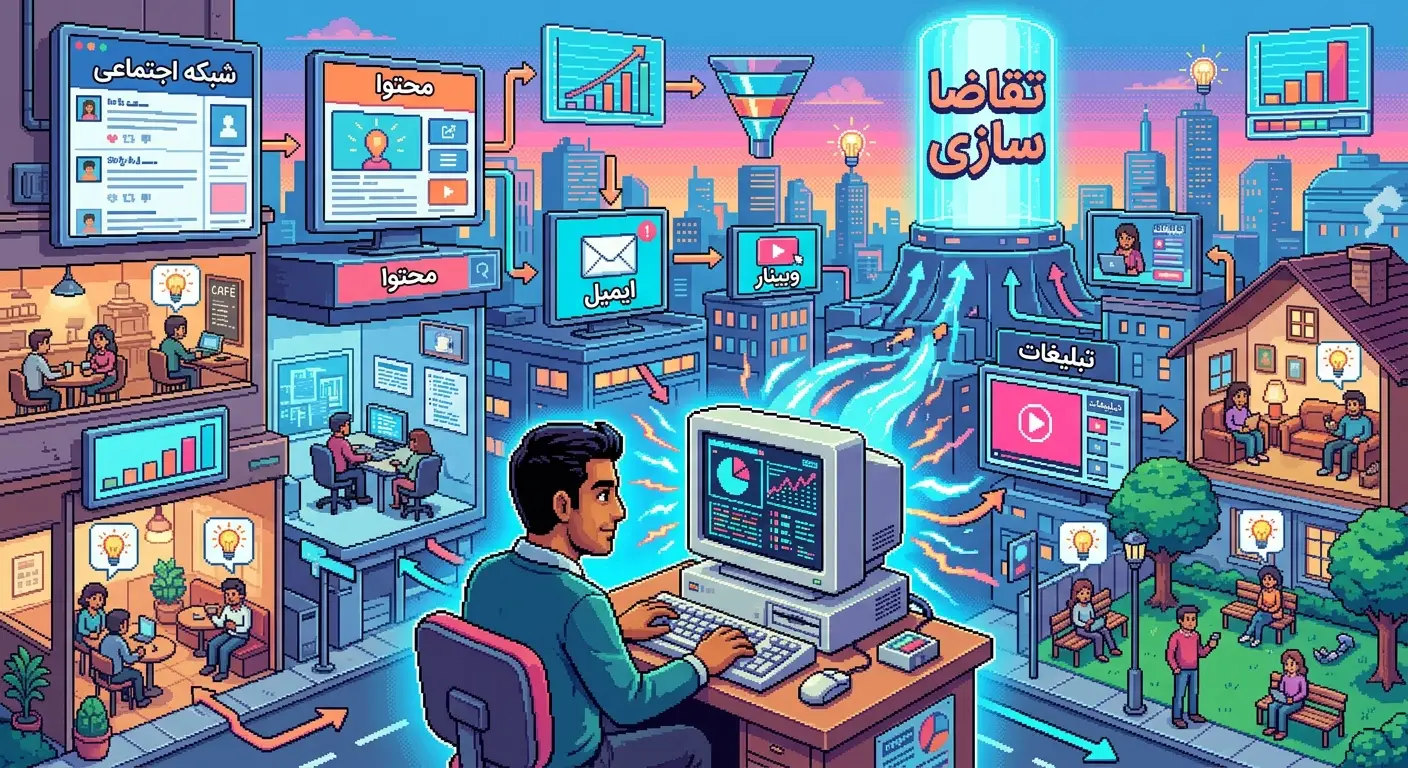
In modern marketing, the main challenge is not always how to attract customers who are ready to buy; the more important question is how to make the market need our product, service, or solution in the first place, become aware of it, consider it, and ultimately enter the buying journey. This is where Demand Generation, or demand creation, becomes important.
Many brands focus only on lead acquisition, pay-per-click ads, sales campaigns, and conversion rates. These activities matter, but they usually address the part of the market that already has some kind of need or buying intent. By contrast, Demand Generation works to educate the market, activate a need, build awareness and trust, and move audiences from indifference or lack of awareness to interest, consideration, and purchase.
From the perspective of a digital marketing and branding agency, Demand Generation is not just an advertising technique; it is a strategic approach to building a market, growing a brand, increasing share of mind, and creating a sustainable stream of demand.
What Is Demand Generation?
Demand Generation is a set of marketing and branding activities intended to create, increase, and nurture demand for a product, service, category, or brand.
Simply put, Demand Generation means helping audiences:
- Recognize a problem or need
- Understand that a solution to the problem exists
- Recognize our brand as a credible option
- Gradually come to trust the brand
- Enter the consideration and buying journey
Demand Generation usually does not focus solely on immediate sales. Its goal is to prepare the market so that when the time to buy comes, your brand is present in the audience’s mind.
In fact, if Lead Generation is mainly about collecting contact information or attracting prospective customers, Demand Generation operates one step earlier and more broadly: building interest, awareness, trust, and intent.
Why Is Demand Generation Important?
In many markets, only a small percentage of audiences are ready to buy at any given moment. A large part of the market either does not yet clearly understand its problem, is unfamiliar with the solutions, or does not yet trust a particular brand.
If a brand focuses only on audiences ready to buy, it gets caught in intense competition, high customer acquisition costs, and price wars. But by investing in Demand Generation, it can establish a place in the audience’s mind before a purchase decision takes shape.
Why Demand Generation matters, in a few key points:
1. Building a market instead of hunting existing demand
Performance Marketing usually works with existing demand—that is, people who are searching, clicking, or intending to buy right now. Demand Generation, however, works to create new demand.
2. Reducing reliance on sales-focused advertising
A brand that generates sustainable demand does not always have to sell through discounts, promotions, or direct advertising alone.
3. Strengthening the brand in the audience’s mind
Demand Generation helps make the brand one of the audience’s top-of-mind options at the moment of decision.
4. Improving lead quality
When audiences have been educated and become familiar with the brand before entering the sales funnel, they generally become higher-quality leads.
5. Long-term impact on growth
Unlike short-term campaigns, Demand Generation builds marketing and branding assets such as content, trust, awareness, branded search, and mental associations.
How Does Demand Generation Differ from Lead Generation?
One of the most common mistakes in digital marketing is treating Demand Generation and Lead Generation as the same thing. They are related, but they are not the same.
Demand Generation
Its primary goal is to create awareness, interest, need, and trust. At this stage, an audience may not yet be ready to buy. The focus is on educating the market, branding, content, thought leadership, and shaping audience perceptions.
Lead Generation
Its primary goal is to obtain contact information or identify interested people. For example, collecting a phone number or email, registering through a form, downloading a file, or requesting a consultation.
Put simply:
Demand Generation creates demand; Lead Generation turns that demand into leads.
If you have Lead Generation but no Demand Generation, you will soon face a shortage of high-quality leads, rising acquisition costs, and declining conversion rates.
How Does Demand Generation Differ from Brand Awareness?
Brand Awareness means that audiences recognize or remember your brand. But Demand Generation goes beyond awareness. Its goal is to turn awareness into interest, need, trust, and ultimately action.
Many people may have seen your brand but still not know why they should need you. Demand Generation works precisely on this gap.
Brand Awareness asks:
“Does the audience know us?”
Demand Generation asks:
“Has the audience understood the problem, taken the solution seriously, and considered our brand a credible option?”
What Role Does Demand Generation Play in the Marketing Funnel?
Demand Generation is present at every stage of the marketing funnel, but its role is much more prominent at the top and middle of the funnel.
1. Top of the funnel: Awareness and education
At this stage, audiences may not yet clearly understand their problem. Educational content, specialist reports, analytical posts, short videos, webinars, and awareness campaigns help them recognize the problem.
2. Middle of the funnel: Interest and consideration
At this stage, audiences compare solutions. Case studies, specialist articles, comparisons, guides, and nurturing emails play an important role.
3. Bottom of the funnel: Conversion and decision
At this stage, audiences are close to purchasing or partnering. Demos, consultations, service pages, tailored offers, social proof, and testimonials can convert the demand already created into sales.
The important point is that Demand Generation is not limited to the awareness stage; it continues through conversion and even after purchase.
Core Components of a Demand Generation Strategy
To implement Demand Generation properly, we must see it as a system, not as a collection of scattered campaigns.
1. Understanding the market and audience
First, we need to know exactly whom we are creating demand for. This understanding includes:
- Audience personas
- Stated and latent needs
- Decision-making barriers
- Economic, technical, or emotional concerns
- The audience’s level of awareness of the problem
- Competitors’ position in their minds
Without a precise understanding of the audience, Demand Generation turns into producing generic, ineffective content.
2. Defining the problem before introducing the solution
One important principle of Demand Generation is that before selling a solution, we must make the problem meaningful to the audience.
For example, if a digital marketing agency wants to offer branding services, it should not simply say, “We do branding.” It should first show the consequences of not having a brand strategy:
- Higher customer acquisition costs
- Inconsistent brand messaging
- Weak differentiation
- Dependence on discounts
- Lower conversion rates
- Failure to build trust
When audiences take the problem seriously, they become more receptive to a solution.
3. Creating educational and analytical content
Content is the backbone of Demand Generation. But not just any content: content that can change the audience’s perspective, clarify the problem, and strengthen the brand’s position.
Examples of suitable content:
- Specialist articles
- Industry reports
- Practical guides
- Educational videos
- Analytical LinkedIn posts
- Webinars
- Podcasts
- Checklists
- Case studies
- Infographics
- Comparisons of methods and solutions
The goal of content in Demand Generation is not just to get clicks; it is to shape perception and build trust.
4. Thought Leadership
In many B2B markets, specialist services, and complex product categories, audiences trust a brand that has “ideas,” not just a “sales pitch.”
Thought Leadership means a brand can offer a clear point of view, in-depth analysis, and a framework for thinking about market issues.
For example, instead of publishing generic content, a digital marketing and branding agency can publish specialist content about topics such as:
- Brand share of mind
- Share of Search
- Dark Social
- Zero-Click Marketing
- Changes in consumer behavior
- The impact of branding on Performance
- The role of content in B2B decision-making
This kind of content creates demand at a higher level.
5. Distributing content through the right channels
Even the best content will not generate demand if it is not distributed properly. Distribution must align with audience behavior.
Common channels:
- SEO and Google search
- Email marketing
- Webinars
- Podcasts
- Content advertising
- Retargeting
- Specialist media
- Communities and private groups
- Dark social
The important point is that Demand Generation does not always start on a website, nor does it always end there. Sometimes the audience’s first encounter with a brand happens through a LinkedIn post, a short video, a message in a private group, or word of mouth.
6. Nurturing the audience
Demand generation is not an instantaneous event. Many audiences do not buy after their first encounter with a brand. Over time, they need to be educated, build trust, and move closer to a decision.
Nurturing methods:
- Educational emails
- Content retargeting
- Sending reports and guides
- Invitations to webinars
- Presenting case studies
- Publishing comparative content
- Offering an initial consultation
- Content tailored to different funnel stages
Nurturing turns raw demand into serious interest and then into a sales opportunity.
Real-World Examples of Demand Generation
Example 1: Digital marketing agency
Suppose an agency wants to create demand for brand strategy and digital marketing services. Instead of only advertising “professional digital marketing services,” it could create content such as:
- Why does Performance become more expensive without branding?
- How does Share of Search indicate brand health?
- Why are so many leads low quality?
- The role of Dark Social in B2B customer decision-making
- How does content warm up a sales funnel?
This content first frames the problem, then steers the audience toward needing specialist advice.
Example 2: SaaS company
Instead of focusing directly on selling its product, a software company first creates content about the problems of managing distributed teams, operational errors, and the costs of lacking automation. It then presents its product as the solution.
Example 3: Education brand
An education brand first shows why the skills currently available in the market are not enough for career growth, then presents its courses as a path to advancement.
Example 4: Financial services brand
A financial company can create demand for its advisory services or tools by educating people about risk management, investment mistakes, financial planning, and market analysis.
Why Is Demand Generation Important in B2B?
In B2B markets, purchasing decisions are usually:
- Longer
- Made by multiple stakeholders
- More dependent on trust
- Riskier
- Dependent on education and careful consideration
That is why Demand Generation is vital in B2B.
In B2B, an audience may not be ready to buy today, but if your brand becomes established in their mind over several months through specialist content, sound analysis, case studies, and a professional presence, they will likely put you on their shortlist when a need arises.
For agencies, consulting firms, SaaS companies, technology companies, enterprise services, and specialist brands, Demand Generation is one of the most important engines of long-term growth.
How Does Demand Generation Work in B2C?
In B2C, demand generation is driven more by stimulating needs, lifestyle, trends, consumer education, and building brand appeal.
For example:
- A skincare brand educates people about the importance of a skincare routine
- A food brand creates content about a healthy lifestyle
- A sports brand encourages regular exercise
- A home goods brand promotes a new style of interior design
Here, too, the principle is the same: before selling a product, the need or desire for it must be activated in the audience’s mind.
The Role of SEO in Demand Generation
SEO is not only about getting traffic from keywords associated with purchase readiness. One important role of SEO in Demand Generation is ensuring the brand is present at different stages of audience awareness and consideration.
Examples of suitable keywords for Demand Generation:
- “Why is the conversion rate low?”
- “How do you build a strong brand?”
- “What is causing the decline in online sales?”
- “What is a sales funnel?”
- “Why aren’t pay-per-click ads working?”
- “Best way to increase brand awareness”
These keywords may not generate sales immediately, but they bring audiences into the brand’s sphere of ideas. If the content is designed well, it can create demand and later convert into a lead or customer.
The Role of Social Media in Demand Generation
Social media, especially LinkedIn and Instagram, is very important for Demand Generation. Audiences do not always visit social media intending to buy, but they can be exposed to a new idea, problem, or need.
Suitable social media content for Demand Generation:
- Educational posts
- Trend analysis
- Customer experience stories
- Short videos
- Carousel slides
- Specialist viewpoints
- Behind-the-scenes process content
- Before-and-after comparisons
- Responses to common market misconceptions
Social media is especially effective for building familiarity and trust.
The Role of Email Marketing in Demand Generation
Email marketing is one of the best nurturing tools in Demand Generation. When an audience joins an email list, they can be educated over time and brought closer to a decision.
Examples of emails:
- Educational email
- Problem-introduction email
- Case study email
- Solution-comparison email
- Webinar invitation email
- Checklist email
- Consultation offer email
Email in Demand Generation should not be sales-focused alone. It should provide value, build trust, and offer a CTA at the right time.
The Role of Performance Marketing in Demand Generation
Contrary to popular belief, Demand Generation is not opposed to Performance Marketing. It should complement it.
Paid advertising can be used to strengthen Demand Generation, provided it does not lead only to a sales landing page.
Examples of smart use:
- Advertising educational content
- Promoting a webinar
- Retargeting visitors to articles
- Showing case studies to warm audiences
- Video campaigns that introduce a problem
- Promoting a specialist report or whitepaper
In effect, Performance can speed up the distribution of Demand Generation.
Important KPIs in Demand Generation
Measuring Demand Generation is more challenging than measuring Lead Generation because its impact is not always immediate and direct. Still, it can be assessed using a combination of metrics.
Top-of-funnel KPIs:
- Reach
- Impression
- Video View
- Engagement Rate
- Save and Share
- Growth in Audience
- Growth in branded searches
- Share of Search
Middle-of-funnel KPIs:
- Visits to specialist articles
- Resource downloads
- Webinar registrations
- Returning user rate
- Time on page
- Email engagement
- Increase in Direct Traffic
- Increase in Branded Traffic
Bottom-of-funnel KPIs:
- Marketing Qualified Leads
- Sales Qualified Leads
- Demo Request
- Consultation Request
- Pipeline Generated
- Conversion Rate
- Customer Acquisition Cost
- Revenue Influenced
The important point is that Demand Generation should not be measured only by the number of leads. Sometimes its most important impact is seen in improved lead quality, lower CAC, higher conversion rates, and growth in branded searches.
Common Mistakes in Demand Generation
1. Confusing Demand Generation with Lead Generation
If all activities end only in a form, phone number, or immediate sale, genuine Demand Generation is probably not happening.
2. Creating superficial content
Generic, repetitive content creates neither a problem nor trust nor differentiation. Demand Generation requires deep content with a distinctive angle.
3. Lacking a distribution strategy
Publishing content without proper distribution has limited impact.
4. Excessive focus on the bottom of the funnel
If you focus only on audiences ready to buy, you will miss out on the future market.
5. Lack of coordination between marketing and sales
In Demand Generation, the sales team needs to know how audiences have been educated and what concerns they bring into a conversation.
6. Measuring incorrectly
If you measure only immediate conversions, you will not see the true value of Demand Generation.
7. Lacking a clear message
Without clear positioning, Demand Generation turns into scattered content production.
How Do You Design a Demand Generation Strategy?
Use this framework to design a professional Demand Generation program:
Step 1: Define the ICP and persona
Identify who your ideal customer is and what problem they have.
Step 2: Determine the audience’s awareness level
Does the audience know the problem? Are they familiar with the solutions? Do they know your brand?
Step 3: Develop the core message
You need to know what belief or perception you want to change in the market’s mind.
Step 4: Build a content map
Design appropriate content for each stage of the funnel.
Step 5: Choose distribution channels
Choose the main channels based on audience behavior.
Step 6: Design a nurturing journey
Decide how the audience will stay connected with the brand after the first interaction.
Step 7: Define KPIs
Define awareness, engagement, demand, lead, and sales metrics separately.
Step 8: Optimize continuously
Use data to refine the message, content, channels, and CTA.
Demand Generation for the Iranian Market
Demand Generation is especially important in the Iranian market because, in many categories, audiences are not yet well acquainted with the concept of the services or the real value of some solutions.
For example, in areas such as:
- Strategic branding
- CRM
- Marketing automation
- Specialist SEO
- Data analysis
- Growth consulting
- B2B services
- Enterprise software
- Specialist education
Many customers first need education. They may know that “sales have fallen” or “advertising is not working,” but not know that the root of the problem lies in positioning, the sales funnel, brand messaging, user experience, or lead quality.
This is where agencies and professional brands can use Demand Generation to mature the market and create higher-quality demand.
Demand Generation, or demand creation, is one of the most important approaches in modern marketing. It refers to a set of activities designed to build awareness, activate needs, create interest, nurture trust, and turn audiences into customers.
Unlike Lead Generation, which focuses mainly on collecting leads, Demand Generation works more deeply with the market’s mindset. Its goal is not merely to collect contact information; it is to create the conditions in which audiences genuinely need your solution and consider your brand a credible option.
For professional brands, especially in B2B markets, specialist services, SaaS, digital marketing agencies, and consulting firms, Demand Generation is a long-term growth engine. This approach helps a brand become more than a hunter of existing demand—it creates demand itself.
Ultimately, if we do not limit digital marketing to campaigns, clicks, and leads, Demand Generation is where branding, content, SEO, social media, advertising, and sales come together in one integrated system.
Frequently Asked Questions About Demand Generation
1. What is Demand Generation?
Demand Generation is a set of marketing activities designed to build awareness, interest, need, and trust in a product, service, or brand.
2. What is the difference between Demand Generation and Lead Generation?
Demand Generation creates demand and interest, while Lead Generation works to turn that interest into a trackable lead. Put simply, Demand Generation comes before Lead Generation and is broader than it.
3. Is Demand Generation only used for B2B?
No. Demand Generation is used in both B2B and B2C, but it is especially important in B2B because the decision-making journey is longer and requires greater trust.
4. Which channels are suitable for Demand Generation?
Channels such as SEO, content, LinkedIn, Instagram, email marketing, webinars, podcasts, content advertising, retargeting, and PR are very useful for Demand Generation.
5. Does Demand Generation directly generate sales?
Sometimes, yes, but its primary goal is not immediate sales. Demand Generation focuses more on building sustainable demand, trust, awareness, and purchase readiness, and influences sales over the long term.
6. What kinds of content are suitable for Demand Generation?
Educational articles, specialist reports, case studies, webinars, short videos, analytical posts, checklists, guides, and thought leadership content are suitable for generating demand.
7. How is Demand Generation related to branding?
Demand Generation is closely related to branding because demand forms more effectively when the brand is credible, distinctive, and trustworthy in the audience’s mind.
8. What are the most important Demand Generation KPIs?
Important metrics include growth in branded searches, Share of Search, engagement, visits to specialist content, webinar registrations, MQL, SQL, demo requests, pipeline generated, and revenue influenced.
9. What is the biggest mistake in Demand Generation?
The biggest mistake is confusing Demand Generation with Lead Generation and measuring all activities solely by the number of completed forms or immediate leads.
10. How can you get started with Demand Generation?
To get started, define your target audience, their main problem, the market’s awareness level, the brand message, content map, distribution channels, and nurturing journey. Then develop the demand-generation system through continuous measurement and optimization.


