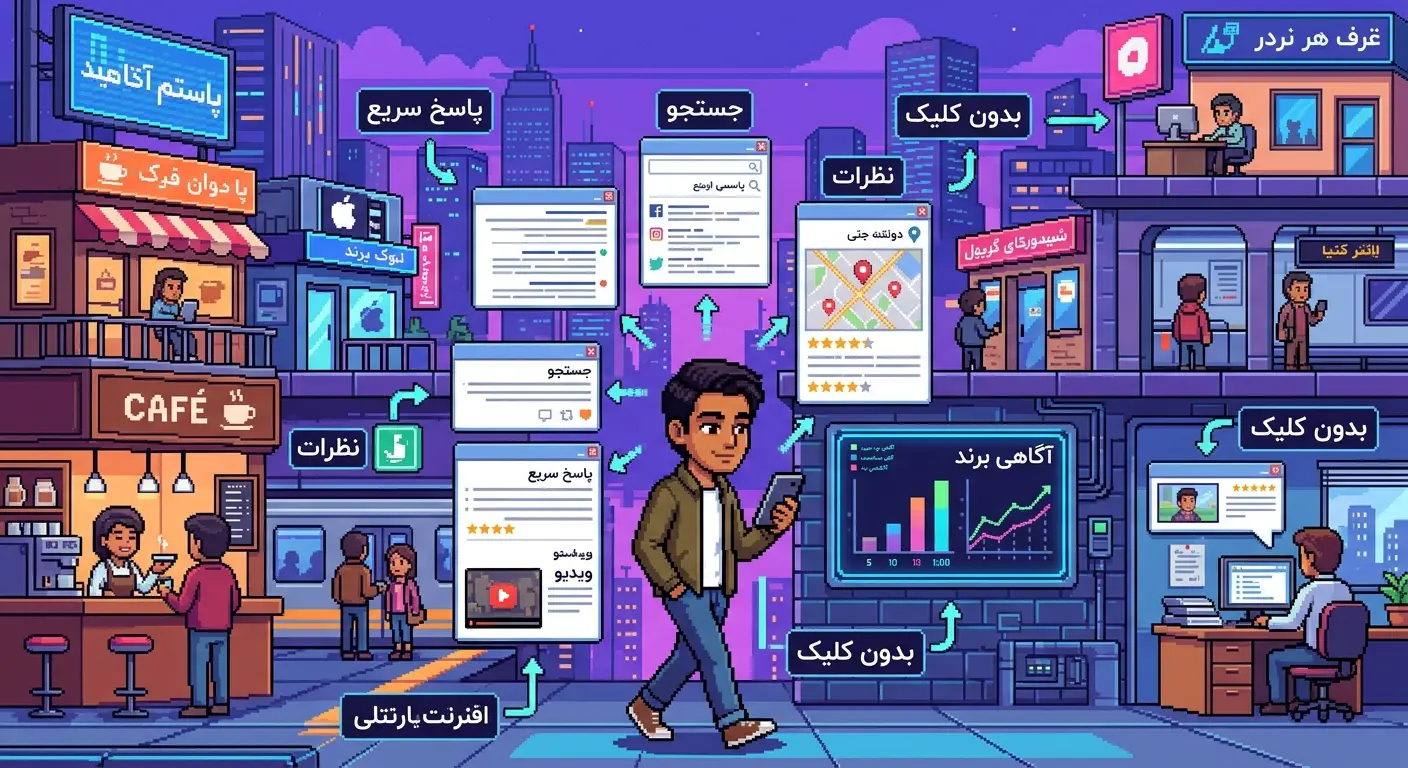
In recent years, one of the most important changes in user behavior and digital platforms has been that reaching an audience no longer necessarily involves a “click.” Much of digital marketing strategy once focused on moving users from a platform to a website, landing page, or product page. Today, however, many platforms prefer to keep users in their own environments. Users themselves also do not always want to click, open multiple tabs, and go through several steps to find an answer. This is where Zero-Click Marketing matters.
Zero-Click Marketing, or marketing without clicks, is an approach to digital marketing that, rather than focusing solely on getting users to click, seeks to deliver value, a message, an experience, or an answer at the initial point of contact—without necessarily requiring users to click a link and visit another page.
For a digital marketing and branding agency, this is not merely a new trend; it signals a deep shift in how content is distributed, brands are built, and effectiveness is measured. If we still measure everything by CTR, Session, and Pageview, we may be missing a significant part of our brand’s actual impact.
In this article, from the perspective of a professional digital marketing specialist, we explore what Zero-Click Marketing is, why it matters, how it differs from traditional marketing, its impact on SEO and branding, and how brands can use it to grow.
What Is Zero-Click Marketing?
Zero-Click Marketing means designing and distributing content, messages, and experiences so that audiences can receive value, get to know a brand, build trust, or even take a next step without clicking.
Put simply, in zero-click marketing you are not just trying to take users off one platform and bring them to your website. You try to deliver your core message where users already are.
For example:
- A LinkedIn post that explains its main point in full
- An Instagram carousel that delivers the complete lesson within the post
- A complete answer in Google results that removes the need to click
- A short video that conveys the brand’s value without requiring a website visit
- A Google Business Profile that provides enough information to call or visit
In this model, a “click” is no longer the only measure of success. Sometimes the brand has already made its impact at that point of contact.
Why Has Zero-Click Marketing Become Important?
The importance of Zero-Click Marketing stems from several major changes in the digital ecosystem:
1. Platforms do not want to lose users
Instagram, LinkedIn, YouTube, TikTok, Google, and many other platforms naturally prefer users to stay in their environments longer. As a result, algorithms often give more attention to content that is consumed more fully within the platform.
2. Users have become accustomed to faster answers
Today’s users have less patience, move faster, and are more results-oriented. They do not want to click a link, open a new page, and scan several paragraphs to get to the point for every simple answer.
3. Zero-click searches have increased
On search engines, many users get their answers directly in the results. Featured snippets, knowledge panels, FAQ rich results, maps, reviews, and AI answers have increased the share of searches that end without a click.
4. Branding does not happen only on websites
It used to be assumed that a brand’s main asset was built on its website. Today, brand perception is shaped across dozens of touchpoints: posts, videos, search results, profiles, reviews, answers, and even comments.
5. Traditional metrics are no longer enough
Content may receive few clicks yet strongly influence brand awareness, mental availability, branded search, and future decisions. If we treat clicks as the only measure of success, we miss part of the picture.
Exactly How Does Zero-Click Marketing Work?
The logic of marketing without clicks is that every piece of content should be an independent unit of value. When users encounter it, they should learn something, feel something, understand the brand, or take a specific action right there.
This model can operate at several levels:
Level One: Delivering a message without leaving the platform
For example, you publish a complete summary of an important analysis in a caption or carousel. Users get all the key points right there.
Level Two: Building a brand without direct traffic
Users see your content several times on LinkedIn and Instagram, remember your brand name, and later search for you when they have a need.
Level Three: Prompting action without a traditional click
For example, a user sees a phone number through a Google Business Profile and calls, or messages you from a LinkedIn post, without ever visiting your website.
Level Four: Influencing decisions
Sometimes users do not click anything, but save your content, show it to a colleague, or remember your brand. This, too, is part of marketing’s impact.
The Difference Between Zero-Click Marketing and Traditional Marketing
Traditional digital marketing was usually based on this sequence:
Content → Click → Website visit → Action
With Zero-Click Marketing, however, the sequence can be redesigned in different ways:
Content → Value received → Brand perception formed
Content → Direct answer → No click needed
Content → In-platform engagement → Trust built
Content → Future branded search → Conversion
The main difference is that clicks were at the center of everything in traditional marketing; in zero-click marketing, “impact” matters more than “clicks.”
This means a professional digital marketing specialist must think beyond classic metrics and understand real user behavior in new environments.
Real-World Examples of Zero-Click Marketing
Let’s review a few practical examples to understand the idea better:
1. A complete educational LinkedIn post
Instead of writing only a headline and saying “Read the rest on the blog,” you write a complete post that conveys the main point itself. The result? More engagement, more saves, and stronger branding.
2. Instagram carousel
In seven or eight slides, users learn about a complete topic. They may not click the link in your bio, but your brand name and expertise stay in their minds.
3. SEO built around Featured Snippets
You create content for which Google displays a concise, precise answer in the results. Users may not click, but they see your brand as a source of answers.
4. Google Business Profile
Users see business hours, address, rating, phone number, and photos directly in search results, then take action without visiting the website.
5. Short educational videos
A 60-second video can convey an important insight, boost your professional credibility, and put your brand in the audience’s memory—even without a single click.
Zero-Click Marketing and SEO
SEO is one of the most important areas where Zero-Click Marketing is evident. For years, SEO focused on attracting clicks from search results. Today, however, many SERPs are designed to give users answers right there.
This happens for several reasons:
- Direct answers
- FAQ snippets
- Featured Snippets
- Knowledge Graph
- Local Pack
- Reviews
- AI-generated summaries
- People Also Ask
This means SEO specialists should no longer focus only on rankings and CTR. They should ask:
- Is my brand visible in the SERP?
- Is my answer displayed in the right place?
- Does my brand gain credibility even without a click?
- Does my presence in the results increase branded searches?
Today, SEO is not only about getting clicks; it is also about shaping “perception.”
Does Zero-Click Marketing Reduce Website Traffic?
Yes, in some cases marketing without clicks may mean some users no longer visit the website. But that is not necessarily a bad thing.
The key question is your objective. If your only KPI is increasing Sessions, you may see Zero-Click Marketing as a threat. But if you consider branding, lead quality, share of mind, and long-term growth, you will see that more clicks do not always produce better results.
Sometimes a user follows this journey without clicking:
- Sees your content
- Understands your expertise
- Remembers your brand name
- Searches for you later when a need arises
- Eventually converts
If you look only at daily traffic, you will not see this journey. But with a more professional perspective, you can see that Zero-Click Marketing builds part of the brand’s hidden funnel.
Zero-Click Marketing and Branding
From a branding perspective, Zero-Click Marketing is a major opportunity. Why? Because it helps you build your brand where the audience’s attention already is.
Many brands still operate with an outdated mindset:
“Let’s just somehow get users to the website.”
But audiences do not always visit your website. You need to bring your brand to diverse touchpoints:
- In search results
- In posts and videos
- On social networks
- In local results
- In quick answers
- In short, easy-to-consume formats
Modern branding means building a consistent perception across all these touchpoints. Zero-Click Marketing teaches you that every touchpoint can itself be a complete brand medium.
Which Brands Need Zero-Click Marketing Most?
Almost every brand can use this approach, but it matters more for some businesses:
B2B brands
Because decisions take longer, and expert content can build trust without a click.
Digital marketing and branding agencies
Because their expertise, credibility, and point of view are conveyed through content and insight, not just direct advertising.
Local businesses
Because many customer actions happen through maps, direct calls, and business profiles.
Content and education brands
Because much of their value lies in sharing knowledge within platforms.
Personal brands
Because people encounter an individual’s content in several environments before visiting their website.
A Zero-Click Marketing Strategy for Agencies and Brands
From a professional agency’s perspective, Zero-Click Marketing should not be treated as a scattered tactic; it should be part of the overall content, distribution, and branding strategy.
1. Design content for in-platform consumption
Instead of creating only a teaser, present the content itself in the destination format.
For example:
- A complete LinkedIn post
- An educational Instagram carousel
- A short video with a specific takeaway
- Precise FAQs for the SERP
2. Present the main message upfront
Do not hide the main point behind a click. If you always provide only an introduction and say “Continue at the link,” you will probably lose many audience members.
3. Redefine your KPIs
Do not look only at CTR and Sessions. These indicators also matter:
- Impressions
- Share of voice
- Brand search volume
- Saves
- Mentions
- Engagement quality
- Direct inquiries
- Assisted conversions
4. Redesign SEO with a zero-click perspective
Plan for featured snippets, People Also Ask, FAQ schema, local search, and entity visibility.
5. Keep the website ready for the next step
Even if the first contact happens without a click, users may eventually visit your website. When they do, they should find a strong, clear, and persuasive experience.
Challenges of Zero-Click Marketing
Despite its many benefits, this approach also has challenges:
1. Measurement becomes harder
Not every effect appears in conventional analytics.
2. Greater direct dependence on platforms
You become more reliant on platform ecosystems.
3. The need to produce higher-quality content
When content must provide value without a click, superficial content no longer works.
4. Attribution is difficult
Users may see content today and convert next week through branded search or a direct call.
5. The need for strategic maturity
Teams that are solely performance-centric may not see the value of this approach.
Which Types of Content Work Best for Zero-Click Marketing?
Not every type of content suits this model, but some formats perform very well:
- Practical lists
- Short, direct how-tos
- Checklists
- FAQs
- Comparisons
- Educational carousels
- Short videos
- Report summaries
- Save-worthy expert tips
- Direct answers to frequently asked questions
What these formats have in common is that they provide clear, immediate value in little time.
Zero-Click Marketing in the Marketing Funnel
A common mistake is to assume that marketing without clicks is useful only for brand awareness. In fact, it can be effective at several funnel stages:
Awareness
Users see your brand name for the first time.
Attention
Good content helps them understand your expertise and value.
Trust
Repeated exposure to useful content builds credibility.
Evaluation
Users remember your brand and turn to you when they need something.
Conversion
They may convert through branded search, a direct message, a call, or a form.
So Zero-Click Marketing is not necessarily anti-conversion; it simply makes the conversion path less linear.
Common Mistakes in Implementing Zero-Click Marketing
Brands sometimes get this concept wrong. Common mistakes include:
1. Removing CTAs completely
Marketing without clicks does not mean having no call to action. You need a smart, relevant, non-intrusive CTA.
2. Providing superficial information
If users are to receive value without clicking, the content must truly be useful, not merely a teaser.
3. Inconsistent branding across platforms
When you appear at multiple touchpoints, your brand message must remain consistent.
4. Neglecting the website
Zero-click does not mean the website no longer matters. The website remains a central brand asset.
5. Measuring only clicks
This is the biggest mistake, because this model’s real impact is usually visible in indirect metrics.
How Do We Measure the Success of Zero-Click Marketing?
To work more professionally, you need to refine your measurement framework. Important indicators include:
- Growth in branded searches
- Increase in Direct traffic, interpreted correctly
- Number of calls and direct messages
- Growth in SERP impressions
- Share of featured snippets
- Content save and share rates
- Increase in branded queries
- Higher-quality leads
- Increase in assisted conversions
- Brand recall in sales conversations
This means looking at SEO, social media, CRM, branded search, and sales data together.
Is Zero-Click Marketing a Threat or an Opportunity?
If you view marketing through an old model, Zero-Click Marketing may seem like a threat: clicks decline, some traffic is lost, and attribution becomes harder.
But with a more professional and strategic perspective, this approach is a major opportunity. It forces you to:
- Create better content
- Communicate your message more clearly
- Show up at real touchpoints
- Define more mature KPIs
- Move away from blind dependence on clicks
Modern marketing is not merely the art of getting clicks; it is the art of building perception, trust, and action in an ecosystem that does not always give you a click.
Conclusion
Zero-Click Marketing, or marketing without clicks, is an approach that, instead of focusing excessively on directing users to a website, seeks to deliver brand value, messages, and experiences to audiences at the initial point of contact. It responds to changing user behavior, evolving algorithms, the growth of zero-click searches, and the spread of environments that prefer to keep users within them.
For brands, digital marketing agencies, and branding teams, Zero-Click Marketing means success can no longer be measured only by clicks. We need to see how well content stays in people’s minds, builds trust, prompts branded searches, and influences future decisions.
From the perspective of a professional team like Chif, Zero-Click Marketing is not just a content tactic; it is a redefinition of marketing solutions, ideas, and processes: a solution for facing a world with fewer clicks, an idea for creating content that provides value on the spot, and a process for measuring impact that cannot necessarily be reduced to clicks.
Ultimately, the brands that succeed in this space are those that can be so useful, clear, and credible that they earn a place in people’s minds even before they visit the website—without begging for a click.
Frequently Asked Questions About Zero-Click Marketing
1. What is Zero-Click Marketing?
Zero-Click Marketing, or marketing without clicks, is an approach to digital marketing that aims to deliver value, a message, or a brand experience without requiring users to click a link and visit another page. In this model, the content itself is designed to be useful and impactful enough within the platform.
2. Why has Zero-Click Marketing become important?
Because user and platform behavior has changed. Users want faster answers, and platforms want to keep users within their ecosystems. As a result, many brand-audience interactions no longer follow the traditional click path.
3. Is Zero-Click Marketing only related to SEO?
No. Although the concept is very important in SEO and search, it is not limited to Google. LinkedIn posts, Instagram carousels, short videos, Google Business Profiles, FAQs, and even email content can all be part of Zero-Click Marketing.
4. How is Zero-Click Marketing different from content marketing?
Content marketing is an umbrella term, while Zero-Click Marketing is a specific approach to content design and distribution. Content is created so it can provide value, build awareness, and affect audiences without requiring a click.
5. Does marketing without clicks reduce website traffic?
In some cases, yes, but that is not necessarily negative. The goal is not only to increase Sessions. If content strengthens the brand, increases branded searches, prompts direct calls, or generates higher-quality leads, it can be highly successful even without more clicks.
6. What types of content are best suited to Zero-Click Marketing?
Short, clear, practical, and direct content performs best, such as FAQs, practical lists, educational carousels, short videos, expert summaries, how-to tips, and quick answers to common questions.
7. Does Zero-Click Marketing work for B2B brands, too?
Yes—in many cases it is highly effective for B2B. Building trust and demonstrating expertise are especially important in this area, and expert content can strongly influence decision-makers even without a click.
8. How can we measure the success of Zero-Click Marketing?
To measure success, look beyond CTR and website traffic. Metrics such as branded searches, impressions, share of voice, content save rates, mentions, direct calls, assisted leads, and engagement quality are important.
9. Do we no longer need a website for Zero-Click Marketing?
No. The website remains one of a brand’s most important assets. Zero-Click Marketing simply means that the first stage of influence does not necessarily happen on the website. A website remains essential for conversion, deeper credibility, data ownership, and the final user experience.
10. What is the biggest mistake brands make with Zero-Click Marketing?
The biggest mistake is assuming content has failed if clicks decline. The same content may have built awareness, trust, and brand recall. Another mistake is producing superficial content and merely labeling it “Zero-Click” without giving audiences real value.


